1.Places you must never park
- Never park on a sidewalk or a boulevard.
- Never park on any part of a crosswalk, or anywhere within an intersection.
- Do not park on a bridge or in an underpass, or on the approaches leading to them.
- Do not park where a traffic control device prohibits stopping or parking.
- Do not park beside another vehicle so that you end up double-parked.
- Do not park beside or across from street construction or an obstruction if your vehicle would block traffic.
- Do not park at or near a fire, explosion, crash or other incident if you would get in the way of traffic or of emergency crews and their equipment.
Official source: Basics of driving ↗
2.No-parking distances and highway shoulders
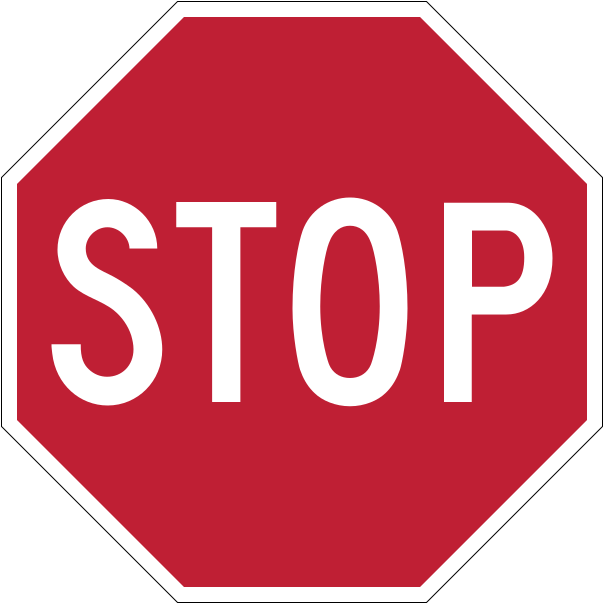
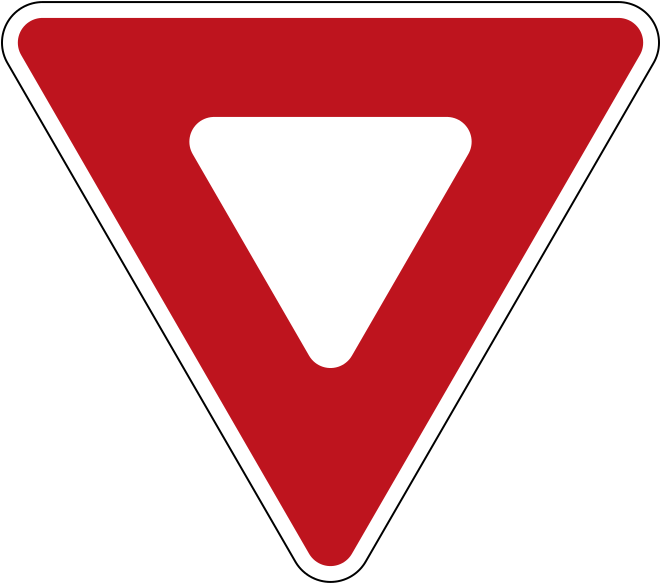
- Stay 5 metres away from a stop sign or a yield sign.
- Stay 5 metres from the nearest side of a marked crosswalk.
- Stay 5 metres from a fire hydrant. If the hydrant is set back from the curb, measure from the point on the curb closest to it.
- Stay 5 metres back from the edge of an intersecting roadway, unless something such as a parking meter shows that parking is allowed there.
- Keep one and a half metres clear of the access to a garage, a private roadway or a driveway.
- Outside an urban area, do not park on the roadway, parking lane or shoulder of a primary highway unless your vehicle cannot move under its own power, an emergency arises, or the law permits it.
- Even then, other vehicles must still have a clear way past, and your vehicle must be visible for 60 metres along the road in both directions.
| Do not park within this distance of… | Distance |
|---|---|
| A stop sign or yield sign | 5 metres |
| The nearest side of a marked crosswalk | 5 metres |
| A fire hydrant (or the nearest point on the curb) | 5 metres |
| The edge of an intersecting roadway (unless parking is indicated) | 5 metres |
| The access to a garage, private roadway or driveway | One and a half metres |
Official source: Basics of driving ↗
3.Signs, markings and stalls for persons with disabilities
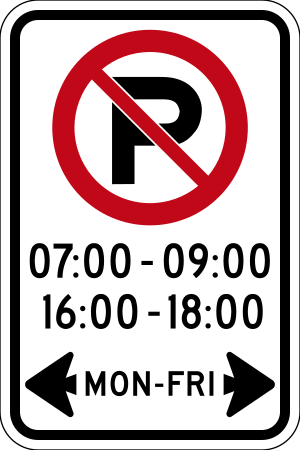
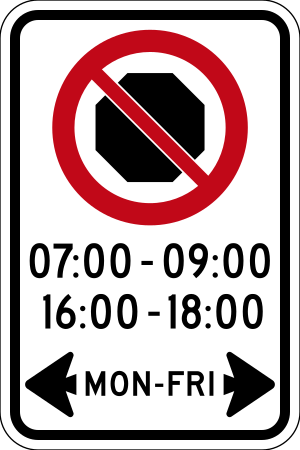
- A no parking sign bans parking during the days and times it shows; a no stopping sign bans even stopping during the days and times it shows.
- The arrow under the symbol shows on which side of the sign the ban applies.
- Do not stop in a no stopping zone marked on the road: it is usually where large vehicles need extra room to turn, and a stopped car gets in the way of turning traffic.
- Vehicles may not drive in a bicycle lane, except to turn or to enter or leave a parking spot beside it. Watch for cyclists when you do.
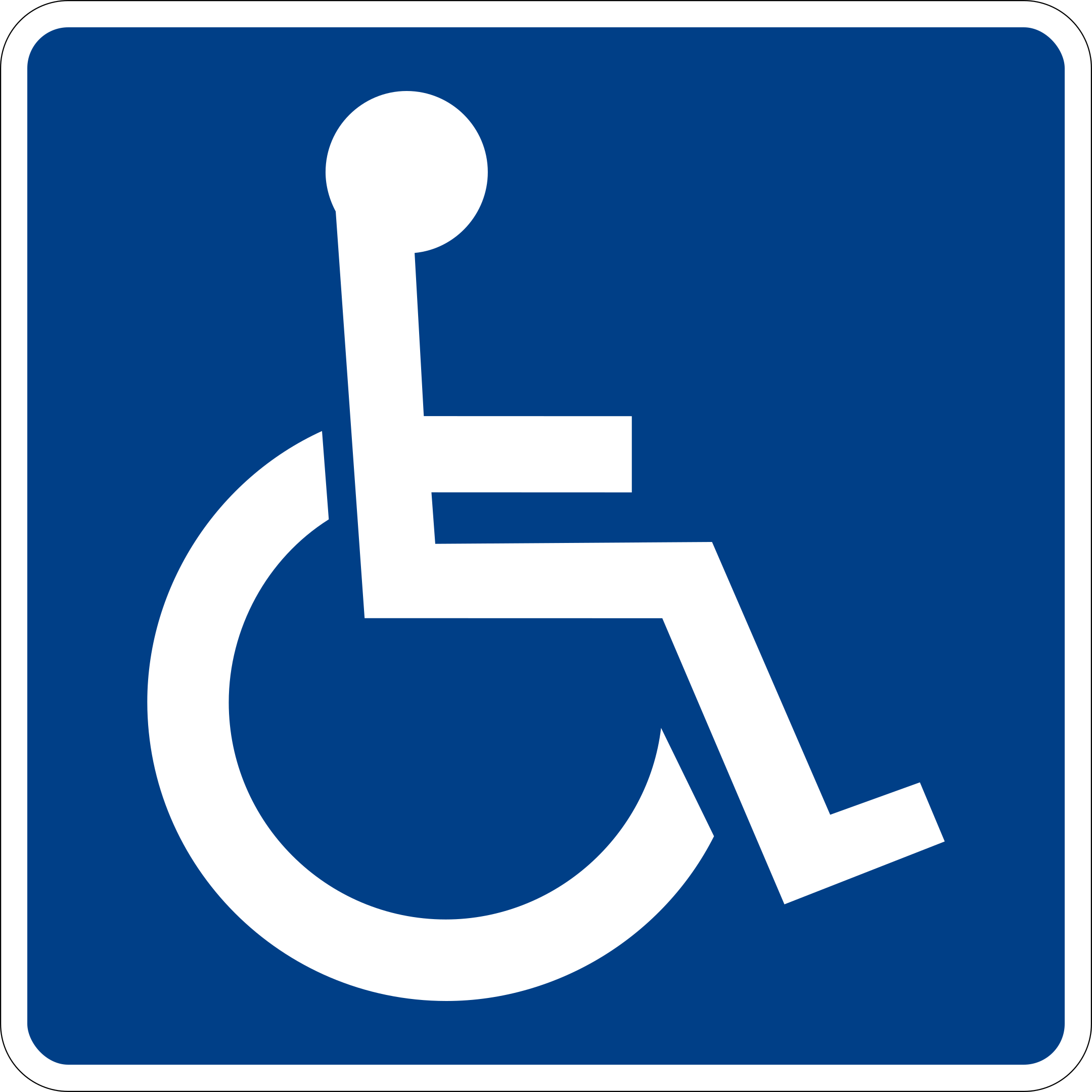
- It is illegal for any vehicle to park or stop in a stall reserved for persons with disabilities unless it displays an identifying parking placard or licence plate.
- These reserved spaces give persons with disabilities safe access to goods and services.
- You can apply for a parking placard for persons with disabilities online, or through a registry agent or a family doctor.
Signs in this section
Official source: Traffic control ↗
4.Parking on a hill
- Facing uphill beside a curb, turn the front wheels left, toward the centre of the road, and let the vehicle roll back slowly until the right front tire touches the curb. The curb then stops it rolling into traffic.
- Facing uphill with no curb, turn the front wheels right, toward the edge of the road, so that if the vehicle moves it goes off the road rather than into traffic.
- Facing downhill, always turn the front wheels right. If there is a curb, let the vehicle roll forward until the right front tire rests against it.
- On any hill, always set the park brake, and put an automatic transmission in park or a manual transmission in low gear.
- These positions are for parking on the right side of the road. When you park on the left side, turn the front wheels the opposite way.
| Parked on the right side | Front wheels | Then |
|---|---|---|
| Uphill, with a curb | Left (toward the centre of the road) | Roll back until the right front tire touches the curb |
| Uphill, no curb | Right (toward the edge of the road) | If it moves, it goes off the road, not into traffic |
| Downhill | Right | With a curb, roll forward until the right front tire touches it |
Official source: Basics of driving ↗
5.Parallel parking
- As you approach, check behind you for traffic, brake gradually well before the space so your brake lights warn others, and make sure the space is long enough.
- Stop beside the vehicle in front of the space with your rear bumpers lined up, parallel to it and about one metre away.
- Shift into reverse, look over your right shoulder and behind you, then reverse straight at a crawl for about half a metre.
- Still moving slowly, steer sharply right until your vehicle is at about 45 degrees to the curb.
- Straighten the front wheels and keep reversing slowly; then turn the wheel sharply left and reverse until you are parallel with the curb, without touching the vehicle behind.
- By law, the wheels of a vehicle parked at the curb must be no more than 50 centimetres from the curb.
Official source: Basics of driving ↗
6.Angle and perpendicular parking
- Angle parking is found mostly in parking lots, with spaces at about 45 degrees to the traffic lane.
- To enter an angle space on the right, signal right, slow down and stay about one and a half metres from the rear of the parked vehicles.
- When you can see along the left side of the vehicle to the right of the empty space, steer sharply right; straighten your wheels at about the middle of the space.
- Creep forward until the front wheel lightly touches the curb or is within 50 centimetres of it.
- Perpendicular spaces are at 90 degrees to the curb. Keep about two metres between you and the rear of the vehicles parked to your right, and finish centred and completely inside the stall.
- Enter an angle or perpendicular stall on your left only in a parking lot, and check for oncoming traffic before you cross its lane.
Official source: Basics of driving ↗
7.Reversing out and pulling away
- Back out of an angle space slowly. It is hard to see traffic as you leave, so yield the right-of-way and look carefully behind you.
- If the vehicle on your right is longer than yours, stop when your rear is even with its rear, check for traffic and pedestrians, then keep reversing straight until you can see past it.
- When your front bumper clears the vehicle on your left, steer sharply right, reverse into the first lane, stop parallel with the curb, then drive ahead, watching for others leaving their stalls.
- To leave a parallel spot with a vehicle in front, check your mirrors, then reverse while looking over your right shoulder until you are close to the vehicle behind, without touching it.
- Then signal left, look over your left shoulder for traffic and cyclists the mirrors miss, and move forward slowly about one metre while steering sharply left before entering the nearest lane.
- When reversing out of a driveway, back into the nearest traffic lane and then drive forward. Never reverse into a second lane.
- It is illegal to reverse into an intersection or a crosswalk.
Official source: Basics of driving ↗
8.Getting in and out safely
- Before getting out on the traffic side, check all mirrors for traffic or cyclists coming from behind, and shoulder check your blind spots to the left.
- When it is safe, open the door only as wide as you need, get out quickly, and walk to the rear of the vehicle, facing traffic, to reach the curb.
- When getting back in, approach the vehicle from the front and look for traffic in the nearest lane before you open the door; close it quickly behind you.
- When parked at the curb, always check for cyclists before opening your door. Waiting until it is safe to open the door is the driver’s responsibility.
- Before you pull away from the curb, check for cyclists who may be riding past your vehicle.
- In residential areas, watch for children around parked vehicles, and glance under the parked vehicles ahead for feet, toys or bicycle wheels.
Official source: Basics of driving ↗ · Sharing the road ↗