Practice session
Rules of the road
Loading…
Every question on this page
The whole pool, with the answer and the explanation for each one. Practise first, then read through anything you were unsure of.
Show all 160 questions with answers
1 of 160 · Getting your licence
What is the minimum age to get a Class 7 learner's licence in Alberta?
- A.14 years oldAnswer
- B.15 years old
- C.16 years old
- D.18 years old
Explanation: You can get a Class 7 learner's licence once you are 14. Stage 1 of Graduated Driver Licensing starts here, and applicants under 18 also need a parent's or guardian's consent.
2 of 160 · Getting your licence
Which applicants for a Class 7 learner's licence need a parent's or guardian's consent?
- A.Applicants under 16
- B.Applicants under 18Answer
- C.Applicants under 21
- D.Every applicant, whatever their age
Explanation: Anyone under 18 needs parental or guardian consent to get a Class 7 licence. The same rule applies later when an applicant under 18 moves up to the Class 5-GDL.
3 of 160 · Getting your licence
Which tests must you pass to get a Class 7 learner's licence?
- A.A knowledge test and a vision testAnswer
- B.A knowledge test and a road test
- C.A vision test and a driver education course
- D.A road test only
Explanation: Stage 1 requires a knowledge test on the rules of the road and a vision test, both taken at a registry agent. The road test comes later, when you move up to the Class 5-GDL.
4 of 160 · Getting your licence
The Class 7 knowledge test has 30 multiple-choice questions. How many must you answer correctly to pass?
- A.20
- B.24
- C.25Answer
- D.All 30
Explanation: You need a score of 25 out of 30 to pass, so you can miss no more than 5 questions. The questions cover safe driving practices, driving laws and road signs.
5 of 160 · Getting your licence
How often may you take the knowledge test if you do not pass?
- A.Once per day, paying for each attemptAnswer
- B.As often as you like on the same day, free of charge
- C.Once every 7 days
- D.Once every 30 days
Explanation: The knowledge test can be taken once per day, and it must be paid for each time you take it. Study the guide well so you pass on your first attempt.
6 of 160 · Getting your licence
Who may supervise a Class 7 learner while they drive a car?
- A.Someone over 18 who holds a full Class 5 licence or higherAnswer
- B.Any driver aged 16 or older, including a Class 5-GDL driver
- C.Any adult passenger, licensed or not
- D.Another Class 7 learner who has held the licence for 12 months
Explanation: Your supervisor must be over 18 and hold a full Class 5 licence or higher. A probationary Class 5-GDL driver does not qualify, and neither does another learner.
7 of 160 · Getting your licence
Where must the supervising driver sit when a Class 7 learner is driving?
- A.In the front passenger seatAnswer
- B.In any seat in the vehicle
- C.Directly behind the driver
- D.In the back seat, so the learner is not distracted
Explanation: The accompanying driver must sit in the front passenger seat, right next to the learner, where they can see the road and give guidance.
8 of 160 · Getting your licence
During which hours is a Class 7 learner not permitted to drive?
- A.From midnight to 5 a.m.Answer
- B.From 10 p.m. to 6 a.m.
- C.From 11 p.m. to 5 a.m.
- D.From 1 a.m. to 6 a.m.
Explanation: Class 7 learners may not drive from midnight to 5 a.m., even with a qualified supervisor beside them. This curfew applies only to the learner stage.
9 of 160 · Getting your licence
How much alcohol may a Class 7 learner have in their body while driving?
- A.None: the alcohol level must be zeroAnswer
- B.Any amount below the limit for fully licensed drivers
- C.A small amount, as long as the supervisor is sober
- D.A small amount, but only on rural roads
Explanation: Learners must have a zero alcohol level every time they drive. The guide adds that the drug level must be zero too.
10 of 160 · Getting your licence
How many people may ride in a vehicle driven by a Class 7 learner?
- A.No more people than there are seat belts in the vehicleAnswer
- B.Only the learner and the supervisor
- C.The supervisor plus 1 other passenger
- D.Any number, if the supervisor agrees
Explanation: A learner may not drive with more people in the vehicle than there are seat belts. Every person must have a belt of their own.
11 of 160 · Getting your licence
At how many demerit points is a Class 7 learner's licence suspended?
- A.4 points
- B.8 pointsAnswer
- C.12 points
- D.15 points
Explanation: A learner is allowed 8 demerit points; reaching that total brings a suspension. New drivers have a much lower limit than fully licensed drivers, so every ticket counts.
12 of 160 · Getting your licence
How long must you hold a Class 7 learner's licence before you can take the road test for a Class 5-GDL licence?
- A.6 months
- B.12 monthsAnswer
- C.18 months
- D.24 months
Explanation: You must hold the Class 7 licence for at least 12 months, be 16 or older, and then pass the road test to become a Class 5-GDL driver.
13 of 160 · Getting your licence
What happens to the minimum learner period if your driving privileges are suspended while you hold a Class 7 licence?
- A.It is extendedAnswer
- B.Nothing: the suspension still counts toward it
- C.It is cancelled, and you may take the road test at once
- D.It is shortened if you take a driver education course
Explanation: The learner stage lasts at least one year, and a suspension of your driving privileges extends that time.
14 of 160 · Getting your licence
What is the minimum age to get a Class 5-GDL (probationary) licence?
- A.14 years old
- B.16 years oldAnswer
- C.17 years old
- D.18 years old
Explanation: You must be at least 16 to hold a Class 5-GDL licence. A learner who started at 14 therefore still waits until 16, even after 12 months on the Class 7.
15 of 160 · Getting your licence
How long is the Class 5-GDL probationary period, and how can it be shortened?
- A.24 months, reduced by up to 6 months with a Class 5 or Class 6 driver training program from a licensed schoolAnswer
- B.12 months, reduced by up to 4 months with a driver training program
- C.36 months, with no way to shorten it
- D.24 months, halved by passing an advanced road test
Explanation: Probation lasts 24 months. Completing a Class 5 or Class 6 driver training program from a school licensed by Transportation and Economic Corridors can cut it by up to 6 months.
16 of 160 · Getting your licence
Do you need to pass an advanced road test to exit the GDL program in Alberta?
- A.No: since April 1, 2023 the advanced road test is no longer requiredAnswer
- B.Yes, after 24 months of probation
- C.Yes, but only drivers under 18
- D.Only if you received demerit points during probation
Explanation: Starting April 1, 2023, drivers no longer take an advanced road test to leave GDL. You exit by meeting the age, probation and clean-record requirements.
17 of 160 · Getting your licence
Besides completing the probationary period, what else is required to get a full Class 5 (non-GDL) licence?
- A.Be at least 18 and free of suspensions and demerits for the last 12 monthsAnswer
- B.Have fewer than 8 demerit points on your record
- C.Pass a second knowledge test
- D.Hold the Class 5-GDL for at least 36 months
Explanation: To become fully licensed you must be at least 18, have completed the 24 months of probation, and be suspension and demerit free for the last 12 months.
18 of 160 · Getting your licence
While you hold a Class 5-GDL licence, which of these are you not allowed to do?
- A.Upgrade to a Class 1, 2, 3 or 4 licenceAnswer
- B.Drive alone, without a supervisor
- C.Drive on a provincial highway
- D.Carry passengers who each have a seat belt
Explanation: Upgrades to Class 1, 2, 3 or 4 are not allowed during GDL. Once you exit GDL and hold a full Class 5, you may re-class to a commercial licence.
19 of 160 · Right-of-way & intersections
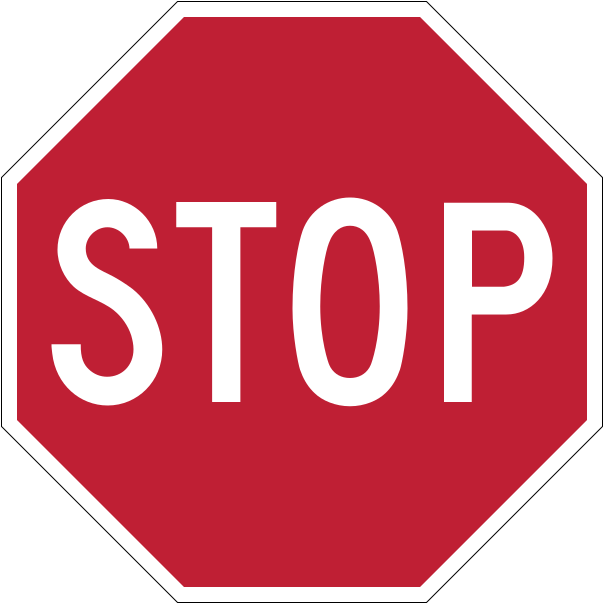
You come to this sign and a stop line is painted on the road. Where must you stop?
- A.Before the stop lineAnswer
- B.With your front bumper over the stop line
- C.At the edge of the cross street, past the line
- D.Wherever you can see best, even past the line
Explanation: Where a stop line is marked, make a complete stop before it. Then give pedestrians and traffic the right-of-way before moving forward.
20 of 160 · Right-of-way & intersections
At a stop sign with no stop line and no marked crosswalk, where must you stop?
- A.Within 3 metres of the intersecting roadwayAnswer
- B.Within 10 metres of the intersecting roadway
- C.Exactly 15 metres before the intersection
- D.Inside the intersection, where you can see both ways
Explanation: With no stop line or marked crosswalk, stop within 3 metres of the intersecting roadway, at a point where you will not interfere with pedestrians who are crossing or about to cross.
21 of 160 · Right-of-way & intersections
At a four-way stop, which vehicle should go first?
- A.The vehicle that arrived and stopped firstAnswer
- B.The vehicle on the busier road
- C.The largest vehicle
- D.The vehicle turning left
Explanation: Three- and four-way stops are "courtesy corners": every vehicle stops, and the one that arrived first proceeds first. Go only when it is safe.
22 of 160 · Right-of-way & intersections
Two vehicles arrive at a four-way stop at the same time. Which one should go first?
- A.The vehicle on the rightAnswer
- B.The vehicle on the left
- C.The vehicle going straight, whatever side it is on
- D.The driver who signals first
Explanation: When two vehicles arrive at the same time, courtesy lets the vehicle on the right proceed first. Always make sure the other driver is yielding before you move.
23 of 160 · Right-of-way & intersections
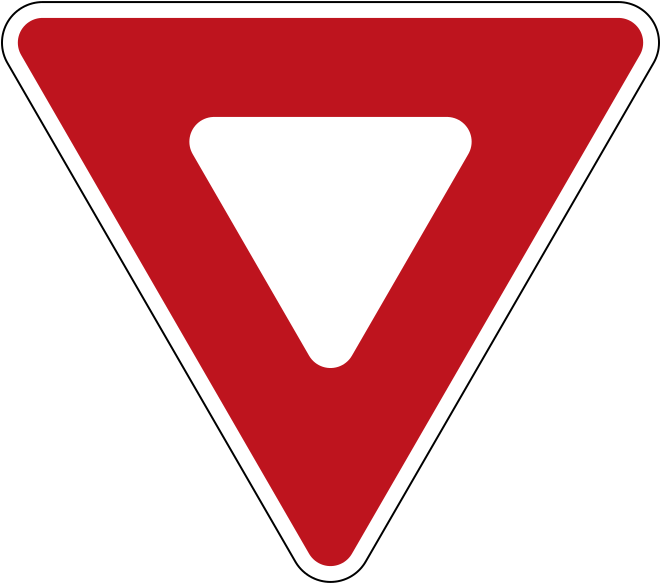
You approach this sign and there are no pedestrians or vehicles you need to yield to. What may you do?
- A.Proceed through without coming to a complete stopAnswer
- B.Come to a complete stop anyway, as at a stop sign
- C.Speed up to merge ahead of any traffic that may come
- D.Stop and wait for a gap of at least 10 seconds
Explanation: A yield sign means slow down and be prepared to stop for traffic or pedestrians. If there is no one you must yield to, you may go through without a full stop.
24 of 160 · Right-of-way & intersections
At an intersection with no signs and no traffic lights, who must you yield to?
- A.A vehicle approaching on your rightAnswer
- B.A vehicle approaching on your left
- C.Nobody; the first vehicle to enter has the right-of-way
- D.Only vehicles larger than yours
Explanation: At an uncontrolled intersection you must yield to a vehicle on your right. Slow down enough to stop easily, and check both left and right because fences, trees or parked cars may block your view.
25 of 160 · Right-of-way & intersections
At a T intersection with no signs or signals, you are driving straight through. A car is waiting on the road that ends at the intersection, on your right. Who has the right-of-way?
- A.The car on your rightAnswer
- B.You, because you are on the through road
- C.You, because you are going straight
- D.Whichever driver sounds the horn first
Explanation: An uncontrolled T intersection follows the same rule: the driver on the right has the right-of-way. The driver going straight through must not assume the road is theirs.
26 of 160 · Right-of-way & intersections
Two cars approach the same crossing aisle in a parking lot with no signs. Which rule applies?
- A.The normal right-of-way rules for intersections without signs or signalsAnswer
- B.No rules apply, because a parking lot is private property
- C.The car heading toward the exit goes first
- D.The larger vehicle goes first
Explanation: Parking lots contain intersections without signs or signals, and the ordinary right-of-way rules apply there, including yielding to the vehicle on your right.
27 of 160 · Right-of-way & intersections
You are driving out of a driveway that crosses a sidewalk onto a main street. What must you do?
- A.Stop before the sidewalk, stop again before the street, and yield to pedestriansAnswer
- B.Slow down and merge without stopping if the street looks clear
- C.Stop only if a pedestrian is already on the sidewalk
- D.Sound the horn to warn pedestrians, then drive out
Explanation: When leaving a service road, alley, parking lot or driveway, stop before any sidewalk crossing, stop before entering the main street, and yield to pedestrians.
28 of 160 · Right-of-way & intersections
Your light is green, but traffic is backed up and there is no room for your car on the far side of the intersection. What should you do?
- A.Wait before the intersection until you can clear it and the far crosswalk completelyAnswer
- B.Enter the intersection, since the light is green
- C.Stop on the far crosswalk so you are ready to move
- D.Enter the intersection and turn on your hazard lights
Explanation: Do not enter an intersection until you can clear it completely, including the crosswalk on the other side. A car stuck in the middle blocks cross traffic and pedestrians when the light changes.
29 of 160 · Right-of-way & intersections
You have the right-of-way, but another driver starts to pull out in front of you. What is your duty?
- A.Do everything you can to prevent a collisionAnswer
- B.Keep going: the other driver must yield
- C.Sound your horn and hold your speed
- D.Nothing: a collision would be entirely the other driver’s fault
Explanation: Right-of-way rules say who should yield, but even with the right-of-way you are still responsible for doing everything you can to prevent a collision.
30 of 160 · Right-of-way & intersections
A police officer directing traffic waves you through an intersection while your light is red. What should you do?
- A.Follow the officer's directionAnswer
- B.Wait for the light to turn green
- C.Follow whichever you saw first
- D.Turn right instead, since that is allowed on red
Explanation: Directions given by a peace officer or police officer override traffic signs and signals, so you follow the officer's signal.
31 of 160 · Right-of-way & intersections
A pedestrian has stepped into a marked crosswalk ahead of you. What must you do?
- A.Yield the right-of-way to the pedestrianAnswer
- B.Continue if the pedestrian is not yet in your lane
- C.Sound your horn so the pedestrian waits
- D.Yield only if a traffic light controls the crosswalk
Explanation: Once a pedestrian has entered a marked or unmarked crosswalk, you must yield the right-of-way and let them finish crossing.
32 of 160 · Right-of-way & intersections
On a multi-lane road, how far back should you stop when stopping for a pedestrian at a crosswalk?
- A.About 2 to 3 car lengths back, so drivers in other lanes can see the pedestrianAnswer
- B.As close to the crosswalk as possible
- C.About 10 car lengths back
- D.With your front wheels on the crosswalk line
Explanation: Stop about 2 to 3 car lengths before the crosswalk. That leaves a clear sight line so traffic in other lanes can see the pedestrian and has time to stop.
33 of 160 · Right-of-way & intersections
An intersection has no painted crosswalk lines. Is there a crosswalk there?
- A.Yes: every intersection has crosswalks, marked or unmarkedAnswer
- B.No: a crosswalk exists only where lines are painted
- C.Only if a pedestrian crossing sign is posted
- D.Only in urban areas with sidewalks
Explanation: All intersections have crosswalks, which may be marked or unmarked. Treat an unmarked crosswalk exactly like a painted one, and never pass a vehicle that has stopped for a pedestrian.
34 of 160 · Right-of-way & intersections
In a city, a pedestrian at the curb raises an arm at a right angle and points to the opposite curb. What does this mean?
- A.They intend to cross; stop safely before the crosswalk and let them crossAnswer
- B.They are hailing a taxi, so you may continue
- C.They are waving you through ahead of them
- D.Nothing, unless they have already stepped onto the road
Explanation: In an urban area, a pedestrian may signal the intention to cross by raising an arm and pointing to the opposite curb. When they do, stop safely before the crosswalk and let them cross.
35 of 160 · Right-of-way & intersections
In which direction does traffic travel around a traffic circle or roundabout?
- A.CounterclockwiseAnswer
- B.Clockwise
- C.Either direction, whichever is shorter to your exit
- D.It depends on the time of day
Explanation: Traffic always circulates counterclockwise around the centre island, so you enter by turning right and keep the island on your left.
36 of 160 · Right-of-way & intersections
You are about to enter a roundabout. Who has the right-of-way?
- A.Traffic already in the circleAnswer
- B.You, as the entering vehicle
- C.Whichever vehicle is on the right
- D.Vehicles on the larger road
Explanation: Vehicles entering a traffic circle or roundabout must yield to the traffic already circulating in it. Wait for a safe gap before you enter.
37 of 160 · Right-of-way & intersections
Inside a two-lane traffic circle, a vehicle in the right lane and one in the left lane are side by side. Who must yield?
- A.The driver on the right yields to the driver on the leftAnswer
- B.The driver on the left yields to the driver on the right
- C.The driver who entered last has the right-of-way
- D.The faster vehicle has the right-of-way
Explanation: While in the circle, drivers on the right must yield to drivers on the left. Take extra care when exiting from the left lane across the right (outside) lane.
38 of 160 · Right-of-way & intersections
You are on a two-way road when an ambulance with its siren sounding comes up behind you. What must you do?
- A.Move as close as possible to the right curb or edge and stop until it has passedAnswer
- B.Speed up to stay ahead of it
- C.Stop right where you are in your lane
- D.Pull to the left side of the road
Explanation: An emergency vehicle sounding its siren has the right-of-way from any direction. On a two-way road, move as close as you can to the right curb or edge, stop until it passes, and check for others before moving on.
39 of 160 · Turning & signalling
How far before an intersection should you be in the proper lane for your turn?
- A.At least 5 metres
- B.At least 15 metresAnswer
- C.At least 50 metres
- D.At least 150 metres
Explanation: Prepare for a turn well in advance: check your mirrors, shoulder check, signal, and be in the proper turning lane at least 15 metres before the intersection.
40 of 160 · Turning & signalling
When turning right from a two-way road onto another two-way road, how close to the curb should you stay?
- A.Not more than one metre from the curb or road edgeAnswer
- B.At least 3 metres from the curb
- C.In the middle of the road, to swing wide
- D.Next to the centre line
Explanation: Stay centred in the turning lane, not more than one metre from the curb or road edge, before, during and after the turn.
41 of 160 · Turning & signalling
You want to turn right and face this light. No sign prohibits the turn. What must you do?
- A.Stop completely at the stop line or crosswalk, then turn when it is safeAnswer
- B.Slow down and turn without stopping if the way is clear
- C.Wait for the light to turn green
- D.Turn right only if a green arrow also appears
Explanation: Unless a sign prohibits it, you may turn right on a red light after coming to a complete stop at the stop line or crosswalk. Yield to pedestrians and traffic before you go.
42 of 160 · Turning & signalling
Which of these is the correct way to complete a turn?
- A.Stay in one lane, without swinging wide across 2 lanesAnswer
- B.Swing wide into 2 lanes so the turn is smoother
- C.Finish in whichever lane has the least traffic
- D.Cut the corner across the curb lane
Explanation: Do not turn wide and occupy 2 lanes when turning. Turn into the proper lane, then change lanes later with a mirror check, shoulder check and signal if you need to.
43 of 160 · Turning & signalling
You are turning left from a two-way road onto another two-way road. Which lanes should you use?
- A.From the lane nearest and to the right of the yellow line, into the lane nearest and to the right of the yellow lineAnswer
- B.From the curb lane, into the curb lane
- C.From the lane nearest the yellow line, into any lane that is free
- D.From any lane, as long as you signal
Explanation: Turn from the lane nearest and to the right of the yellow line into the lane nearest and to the right of the yellow line. Yield to oncoming traffic and to pedestrians crossing on your left.
44 of 160 · Turning & signalling
You are turning left from a two-way road onto a one-way road. Which lane should you turn into?
- A.The first available lane on the left side of the roadAnswer
- B.The lane farthest to the right
- C.The middle lane
- D.Any lane, since all traffic goes the same way
Explanation: Turn from the lane nearest the yellow line into the first available lane on the left side of the one-way road. Yield to oncoming traffic and pedestrians crossing to your left.
45 of 160 · Turning & signalling
You have to stop in the intersection while waiting to complete a left turn. How should your front wheels be pointed?
- A.Straight aheadAnswer
- B.Turned to the left, ready to go
- C.Turned to the right
- D.It does not matter
Explanation: Stay to the right of the yellow line and keep your front wheels pointed straight ahead. If you are hit from behind, your car will not be pushed into oncoming traffic.
46 of 160 · Turning & signalling
When may you turn left on a red light in Alberta?
- A.From a one-way road onto another one-way road, after a complete stop, if no sign prohibits itAnswer
- B.From any road, after a complete stop
- C.From a two-way road onto a one-way road, without stopping
- D.Never
Explanation: If no sign prohibits it, you may turn left on red from a one-way road onto another one-way road after a complete stop at the stop line or crosswalk, when the turn can be done safely. Yield to pedestrians crossing to your left.
47 of 160 · Turning & signalling
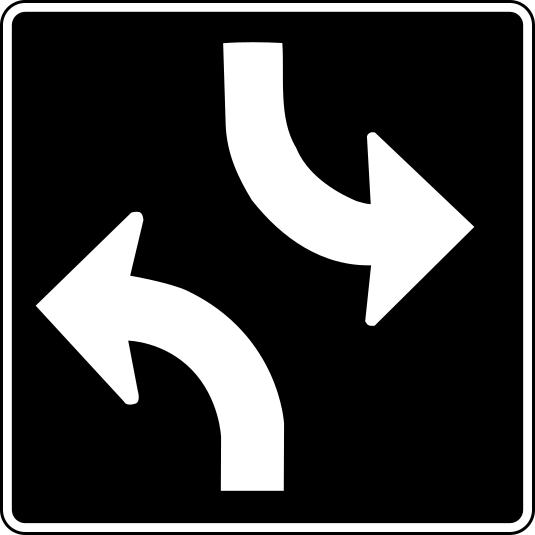
How should you use the two-way left turn lane shown by this sign?
- A.Cross the solid yellow line to enter it close to where you will turn leftAnswer
- B.Use it as a passing lane when traffic is slow
- C.Enter it as early as possible and drive in it for several blocks
- D.Never cross the solid yellow line to enter it
Explanation: Vehicles from both directions share this centre lane to turn left. You may cross the solid yellow line to enter it, but enter only close to where you will turn and watch for oncoming vehicles using the same lane.
48 of 160 · Turning & signalling
At an intersection marked for dual left turns, how do you make your turn?
- A.Approach in one of the marked lanes and turn into the corresponding laneAnswer
- B.Turn into whichever lane is emptier
- C.Change lanes during the turn if needed
- D.Swing wide to leave room for the vehicle beside you
Explanation: Where dual lane turns are marked, stay in your lane from start to finish and turn into the matching lane. Never swing wide or change lanes, because another vehicle may be turning beside you.
49 of 160 · Turning & signalling
May you make a U-turn at an intersection controlled by traffic lights?
- A.No, unless a traffic control device permits itAnswer
- B.Yes, whenever the light is green
- C.Yes, but only on a red light after stopping
- D.Yes, if no other vehicles are in sight
Explanation: U-turns are not permitted at an intersection controlled by traffic lights unless a traffic control device permits them, and never where a sign prohibits them. Any U-turn must also be safe.
50 of 160 · Turning & signalling
In an urban area, which of these U-turns is not permitted, even if it would be safe?
- A.A U-turn on a roadway between intersectionsAnswer
- B.A U-turn at an uncontrolled intersection with a clear view, where no sign prohibits it
- C.A U-turn at a stop-sign intersection where no sign prohibits it
- D.A U-turn at a signal-controlled intersection where a sign permits it
Explanation: In urban areas U-turns are not allowed on a roadway between intersections, at an alley intersection, or at an intersection with an access to a parking lot open to the public.
51 of 160 · Turning & signalling
Outside urban areas, a U-turn is also not permitted near the crest of a hill where another driver approaching within what distance cannot see you?
- A.50 metres
- B.100 metres
- C.150 metresAnswer
- D.300 metres
Explanation: On rural roads, do not make a U-turn on a curve, or on the approach to or near the crest of a hill where a driver within 150 metres, from either direction, cannot see you.
52 of 160 · Turning & signalling
You have driven slightly past the street you wanted. May you back up into the intersection to make the turn?
- A.No: it is illegal to reverse into an intersection or a crosswalkAnswer
- B.Yes, if you use your hazard lights
- C.Yes, if no pedestrians are in the crosswalk
- D.Yes, as long as you back up slowly
Explanation: Moving your vehicle in reverse into an intersection or a crosswalk is illegal. Continue ahead and find a legal, safe way to get back to your route.
53 of 160 · Speed limits
Unless a sign shows otherwise, what is the maximum speed on a roadway within an urban area?
- A.40 km/h
- B.50 km/hAnswer
- C.60 km/h
- D.70 km/h
Explanation: The default limit on a roadway within an urban area is 50 km/h unless otherwise posted. Municipalities may set different limits by bylaw, so always watch the signs.
54 of 160 · Speed limits
Unless otherwise posted, what is the maximum speed on a provincial highway outside an urban area?
- A.80 km/h
- B.90 km/h
- C.100 km/hAnswer
- D.110 km/h
Explanation: A provincial highway outside an urban area has a maximum of 100 km/h unless another limit is posted. Inside a city, the same highway drops to 80 km/h unless posted otherwise.
55 of 160 · Speed limits
You are on a rural roadway that is not a provincial highway, and no speed sign is posted. What is the maximum speed?
- A.60 km/h
- B.80 km/hAnswer
- C.90 km/h
- D.100 km/h
Explanation: A roadway outside an urban area has a maximum of 80 km/h unless otherwise posted. The 100 km/h default applies only to provincial highways, which carry a numbered route marker.
56 of 160 · Speed limits
Unless another speed is posted, what is the speed limit in this zone while it is in effect?
- A.20 km/h
- B.30 km/hAnswer
- C.40 km/h
- D.50 km/h
Explanation: A school sign with a maximum speed marks a school zone. The limit in both urban and rural school zones is 30 km/h unless otherwise posted, and passing a vehicle going the same way is not allowed while the zone is in effect.
57 of 160 · Speed limits
Unless a municipality posts different times, when is a school zone in effect?
- A.On school days only: 8:00 a.m. to 9:30 a.m., 11:30 a.m. to 1:30 p.m. and 3:00 p.m. to 4:30 p.m.Answer
- B.Every day, from 8:30 a.m. until 1 hour after sunset
- C.On school days, from 7:00 a.m. to 6:00 p.m.
- D.At all times, 24 hours a day
Explanation: School zones apply on school days only, from 8:00 a.m. to 9:30 a.m., 11:30 a.m. to 1:30 p.m. and 3:00 p.m. to 4:30 p.m. If a municipality sets other times by bylaw, they are posted beneath the school sign.
58 of 160 · Speed limits
Unless other times are posted, when is this zone in effect?
- A.Every day, from 8:30 a.m. until 1 hour after sunsetAnswer
- B.On school days only, from 8:00 a.m. to 4:30 p.m.
- C.Every day, from sunrise to sunset
- D.Only in summer, from 9:00 a.m. to 9:00 p.m.
Explanation: Unlike school zones, playground zones apply every day, weekends included, from 8:30 a.m. until 1 hour after sunset. Municipal bylaws may set other times, which are posted beneath the playground sign.
59 of 160 · Speed limits
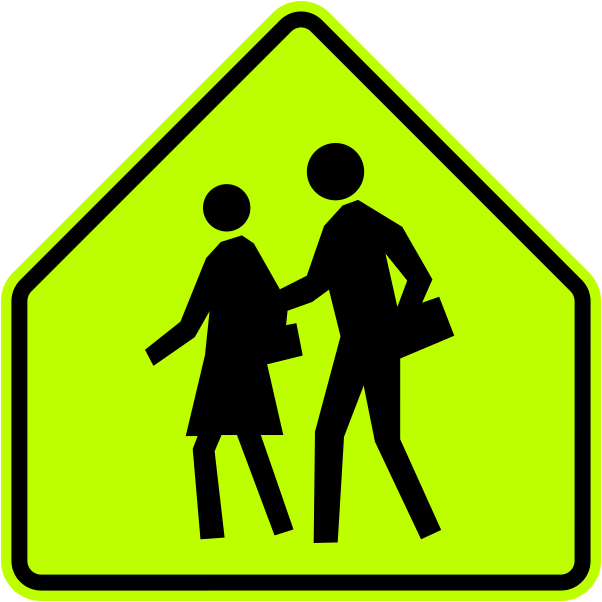
You pass this school sign with no speed sign attached. What does it require of you?
- A.Drive with caution because children may be walking or crossing; it sets no reduced speed limitAnswer
- B.Slow to 30 km/h at all times
- C.Stop and wait for a crossing guard
- D.Nothing, unless it is a school day
Explanation: A school sign without a speed sign marks a school area, not a school zone. It warns that children may be walking or crossing, so drive with caution; the speed change applies only where a maximum speed is posted.
60 of 160 · Speed limits
It is snowing heavily and you are driving exactly at the posted speed limit. Which statement is correct?
- A.You may be breaking the law: any speed that is unsafe for the conditions is illegalAnswer
- B.You are legal, because you are not over the limit
- C.You should speed up to keep up with the flow of traffic
- D.Speed limits are suspended in bad weather
Explanation: A speed limit is the maximum permitted when conditions are ideal, not a target. When the road, weather or traffic is poor, slow down: any speed unsafe for the current conditions is illegal.
61 of 160 · Speed limits
You are about to pass a tow truck stopped at the roadside with its lights flashing, in the lane right next to it. How fast may you go?
- A.60 km/h or the posted speed, whichever is lowerAnswer
- B.30 km/h, whatever the posted speed
- C.80 km/h or the posted speed, whichever is lower
- D.The posted speed; the rule is only for police vehicles
Explanation: Slow to 60 km/h or the posted speed, whichever is lower, when passing stopped emergency vehicles or tow trucks with lights flashing. The rule covers the lanes immediately next to them, and the speeding fine there is doubled.
62 of 160 · Speed limits
Under normal road and weather conditions, what is the minimum following distance behind the vehicle ahead?
- A.1 second
- B.2 secondsAnswer
- C.3 car lengths, whatever your speed
- D.5 seconds
Explanation: Stay at least 2 seconds behind the vehicle ahead in normal conditions, and increase the gap when conditions are less than ideal. Count the seconds from when the vehicle ahead passes a fixed object; the 2-second rule works at any speed.
63 of 160 · Speed limits
What minimum following distance is recommended for drivers of large vehicles such as motor homes?
- A.2 seconds
- B.3 seconds
- C.4 secondsAnswer
- D.8 seconds
Explanation: Large vehicles such as motor homes need more room to stop, so a minimum 4-second following distance is recommended instead of the usual 2 seconds.
64 of 160 · Speed limits
Which three distances add up to your total stopping distance?
- A.Perception distance + reaction distance + braking distanceAnswer
- B.Following distance + reaction distance + braking distance
- C.Reaction distance + braking distance + skid distance
- D.Perception distance + following distance + visual lead
Explanation: Total stopping distance is the distance travelled while you recognise the danger (perception), while you move your foot to the brake (reaction), and while the brakes bring the vehicle to a stop (braking).
65 of 160 · Speed limits
On average, how long does it take a driver to move their foot from the accelerator to the brake (reaction time)?
- A.About three-quarters of a secondAnswer
- B.About one-tenth of a second
- C.About 2 seconds
- D.About 5 seconds
Explanation: The average reaction time is about three-quarters of a second, and recognising the danger can take about the same again. Your vehicle keeps moving at full speed through both before braking even begins.
66 of 160 · Speed limits
What is the minimum distance you should keep when following an emergency vehicle with its siren or lights operating?
- A.50 metres
- B.100 metres
- C.150 metresAnswer
- D.300 metres
Explanation: Always yield to emergency vehicles with siren or lights operating, and keep a safe following distance of at least 150 metres behind them.
67 of 160 · Passing, lanes & freeways
What does a yellow line on the road tell you, and where should it be?
- A.Traffic on each side travels in opposite directions; it should always be on your leftAnswer
- B.Traffic on each side travels in the same direction; it should be on your right
- C.It marks the edge of the shoulder; it should be on your right
- D.It marks a lane reserved for buses
Explanation: Yellow lines separate traffic moving in opposite directions, and a yellow line should always be on the driver’s left. If it is on your right, you are going the wrong way.
68 of 160 · Passing, lanes & freeways
The centre of a two-lane road has a solid yellow line beside a broken yellow line. Who may pass?
- A.Only the driver with the broken line on their sideAnswer
- B.Only the driver with the solid line on their side
- C.Drivers in both directions
- D.No one, in either direction
Explanation: With a solid and a broken yellow line together, passing is permitted only for the driver who has the broken line on their side. The driver with the solid line on their side must not pass.
69 of 160 · Passing, lanes & freeways
In Alberta, what does a single solid yellow centre line mean for passing?
- A.Within an urban area you may pass across it when it is safe; elsewhere passing is not permittedAnswer
- B.Passing is never permitted anywhere
- C.Passing is permitted anywhere when it is safe
- D.Passing is permitted only on rural highways
Explanation: Alberta allows passing safely across a single solid yellow line within an urban area. In all other cases, single or double solid yellow lines mean passing is not permitted.
70 of 160 · Passing, lanes & freeways
What does a solid white line between two lanes going the same way mean?
- A.Lane changing is not permittedAnswer
- B.Lane changing is permitted with care
- C.Traffic on the other side travels in the opposite direction
- D.The lane ends ahead
Explanation: White lines separate traffic travelling in the same direction. A solid white line means lane changing is not permitted; a broken white line means it is.
71 of 160 · Passing, lanes & freeways
On a multi-lane highway, which lane should slower traffic use?
- A.The lane furthest to the right, unless it needs the left lane to turn leftAnswer
- B.The left lane, so it is not in the way of merging traffic
- C.Any lane, as long as it stays at the speed limit
- D.The emergency stopping lane
Explanation: Slower traffic should use the travel lane furthest to the right, unless it needs the left lane to turn left. That leaves the left lane free for other drivers to pass.
72 of 160 · Passing, lanes & freeways
You are driving in the right lane of a highway passing lane, and signs warn that it is ending. What happens next?
- A.You merge safely to the left, and drivers in the left lane cooperate to let you inAnswer
- B.Drivers in the left lane must move right to make room for you
- C.You have the right-of-way and may keep going
- D.You continue on the shoulder until there is a gap
Explanation: Slower vehicles move into the right lane of a passing lane so others can pass on the left. As it ends, drivers in the right lane must merge safely to the left, and drivers in the left lane must cooperate to let them merge.
73 of 160 · Passing, lanes & freeways
You are passing a vehicle on a two-lane highway. When may you start returning to your original lane?
- A.Once the passed vehicle is visible in your inside rear view mirror, after a right shoulder check and right signalAnswer
- B.As soon as your front bumper is past its front bumper
- C.When you see it in your right outside mirror only
- D.When its driver flashes the headlights at you
Explanation: Return only when the vehicle you passed is visible in your inside rear view mirror. Then shoulder check to the right, signal right, move back while keeping your speed, and turn the signal off.
74 of 160 · Passing, lanes & freeways
While passing another vehicle, may you go over the speed limit to finish the pass quickly?
- A.No: it is illegal to exceed the speed limit when passingAnswer
- B.Yes, by up to 20 km/h
- C.Yes, as long as the pass is safe
- D.Yes, but only on a two-lane highway
Explanation: Exceeding the speed limit when passing is illegal. If you cannot complete the pass within the limit, while passing is still permitted and with no oncoming traffic, do not start it.
75 of 160 · Passing, lanes & freeways
Another driver is passing you on a two-lane highway. How can you help?
- A.Stay in your lane and move to the right side of itAnswer
- B.Speed up so the pass takes less time
- C.Move to the left side of your lane so they can see you
- D.Drive onto the shoulder and stop
Explanation: When being passed, stay in your lane and move to its right side to give the passing driver a better view of the road ahead.
76 of 160 · Passing, lanes & freeways
On a multi-lane street, the vehicle in the lane beside you has stopped at a crosswalk to let a pedestrian cross. What should you do?
- A.Do not pass it; stop as wellAnswer
- B.Pass it carefully, since your lane is clear
- C.Sound your horn and continue
- D.Change into its lane and wait behind it
Explanation: You must not pass a vehicle that has stopped for a pedestrian. The stopped vehicle can hide the pedestrian from you until it is too late to stop.
77 of 160 · Passing, lanes & freeways
On a highway with one lane in each direction, where is passing unsafe and illegal?
- A.On a curveAnswer
- B.On a straight stretch with a broken yellow line and no oncoming traffic
- C.In a signed passing lane
- D.Where your side has the broken line of a solid-and-broken pair
Explanation: Do not pass on curves on highways with one lane in each direction: it is unsafe and illegal. For the same reason, never pass near the top of a hill, where you cannot see what is ahead.
78 of 160 · Passing, lanes & freeways
Traffic ahead on the highway is slow. May you use the emergency stopping lane (the shoulder) to get past?
- A.No: do not drive or pass in the emergency stopping laneAnswer
- B.Yes, if you signal and drive slowly
- C.Yes, to pass a vehicle turning left
- D.Yes, during rush hour only
Explanation: The emergency stopping lane is for drivers who must stop because of an urgent situation or a vehicle problem. Do not drive in it, and do not pass or help another vehicle pass you by using it.
79 of 160 · Passing, lanes & freeways
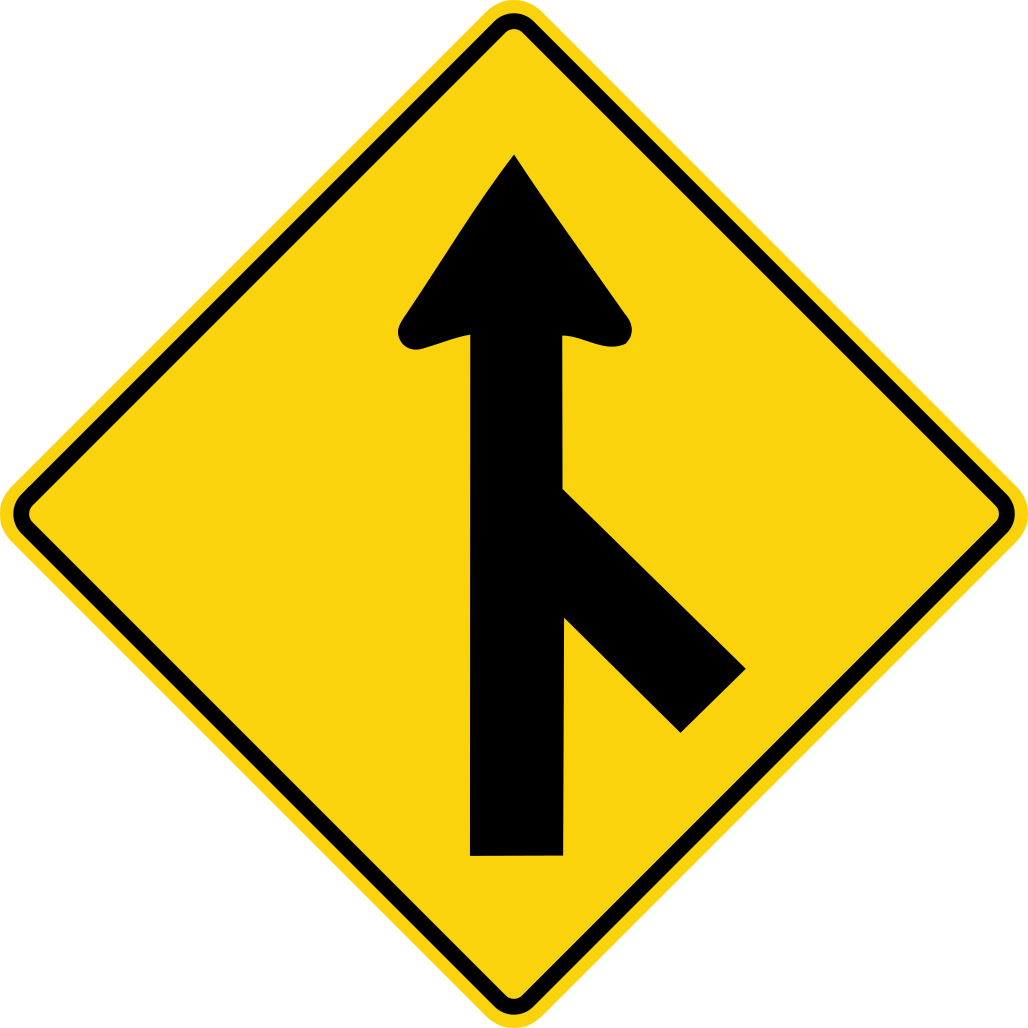
Where an on-ramp merges with a highway, who has the right-of-way?
- A.No one has it: merging is a shared responsibilityAnswer
- B.The merging vehicle
- C.Vehicles already on the highway, and the merging vehicle must stop if needed
- D.Whichever vehicle is larger
Explanation: Neither the merging vehicle nor the vehicles already on the highway have the right-of-way. The merging driver matches traffic speed in the acceleration lane, and drivers on the main road move left if safe or adjust to leave a gap.
80 of 160 · Passing, lanes & freeways
You realise too late that you have missed your exit on a highway. What should you do?
- A.Do not stop; continue to the next exit and plan a way back to your routeAnswer
- B.Stop on the shoulder and reverse back to the exit
- C.Brake hard and cut across to the exit ramp
- D.Make a U-turn across the median
Explanation: If you miss your exit, do not stop. Continue to the next exit and plan how to return to your route. Never stop and reverse on a highway, its emergency stopping lane or its shoulder.
81 of 160 · Parking & stopping
In Alberta, what is the closest you may park to a fire hydrant?
- A.3 metres
- B.5 metresAnswer
- C.10 metres
- D.15 metres
Explanation: Do not park within 5 metres of a fire hydrant. If the hydrant is set back from the curb, measure the 5 metres from the point on the curb nearest to it, so fire crews can always reach it.
82 of 160 · Parking & stopping
How far must you stay from the entrance to a garage, private roadway or driveway when you park?
- A.One and a half metresAnswer
- B.Half a metre
- C.6 metres
- D.No distance is required
Explanation: Leave at least one and a half metres clear of any access to a garage, private roadway or driveway so the owner can get in and out.
83 of 160 · Parking & stopping
Which of these places is a no-parking location under Alberta rules?
- A.On a bridge or on the approach to a bridgeAnswer
- B.At a working parking meter along the curb
- C.In a marked stall in a shopping-centre lot
- D.Beside a curb well away from any hydrant, crosswalk or sign
Explanation: Parking on a bridge, in an underpass or on the approaches to either is prohibited: a stopped vehicle there blocks traffic where there is no room to get around it.
84 of 160 · Parking & stopping
When you parallel park, the law requires your wheels to be no more than how far from the curb?
- A.50 centimetresAnswer
- B.1 metre
- C.2 metres
- D.10 centimetres
Explanation: A parallel-parked vehicle must have its wheels within 50 centimetres of the curb, so it does not stick out into the traffic lane.
85 of 160 · Parking & stopping
You park facing uphill on the right side of a street that has a curb. How should you set your front wheels?
- A.Turned left, then let the vehicle roll back until the right front tire touches the curbAnswer
- B.Turned right, toward the curb
- C.Straight ahead, parallel to the curb
Explanation: Facing uphill with a curb, turn the wheels left, toward the centre of the road, and let the vehicle roll back gently until the right front tire rests against the curb. If the vehicle starts to move, the curb stops it from rolling into traffic.
86 of 160 · Parking & stopping
You park facing downhill on the right side of the road. Which way should your front wheels point?
- A.To the rightAnswer
- B.To the left
- C.Straight ahead
Explanation: Facing downhill, always turn the front wheels to the right, toward the edge of the road or curb. If the vehicle starts to roll, it goes off the road instead of into traffic.
87 of 160 · Parking & stopping
Besides turning the wheels, what else should you always do to keep a vehicle parked on a hill from rolling?
- A.Set the park brake and put an automatic in Park or a manual in a low gearAnswer
- B.Leave the transmission in Neutral so the brakes are not strained
- C.Switch on the hazard lights and leave the engine idling
Explanation: On any hill, set the park brake and leave an automatic in Park or a manual in a low gear. The wheel position is only a back-up in case the vehicle moves anyway.
88 of 160 · Parking & stopping
Your vehicle breaks down and cannot move on a primary highway outside an urban area. Besides leaving clear passage for other vehicles, what must be true if it stays on the shoulder?
- A.It can be seen for 60 metres along the road in both directionsAnswer
- B.It is at least 15 metres from the nearest driveway
- C.It is left there for no more than 10 minutes
Explanation: Outside urban areas you may not park on the roadway, parking lane or shoulder of a primary highway unless the vehicle cannot move, there is an emergency, or the law permits it — and even then there must be clear passage and the vehicle must be visible for 60 metres in both directions.
89 of 160 · Parking & stopping
When may you park or stop in a stall reserved for persons with disabilities?
- A.Only when the vehicle displays an identifying parking placard or licence plateAnswer
- B.Whenever you stay in the vehicle with the engine running
- C.After business hours, when the lot is nearly empty
Explanation: It is illegal for any vehicle to park or even stop in a stall reserved for persons with disabilities unless it has the identifying placard or licence plate. Placards are available through a registry agent.
90 of 160 · Parking & stopping
How close to a stop sign or yield sign may you park?
- A.No closer than 5 metresAnswer
- B.No closer than 1 metre
- C.No closer than 20 metres
- D.Right beside it, if the curb is not painted
Explanation: Do not park within 5 metres of a stop sign or yield sign. A parked vehicle there would hide the sign from approaching drivers.
91 of 160 · Sharing the road
Who does Alberta law require to wear an approved bicycle safety helmet?
- A.Cyclists and bicycle passengers under 18 years of ageAnswer
- B.Only cyclists riding on a highway
- C.Only children under 12
- D.Nobody; helmets are only recommended
Explanation: Any cyclist or bicycle passenger under 18 years of age must wear an approved bicycle safety helmet.
92 of 160 · Sharing the road
A person is walking beside a bicycle and pushing it across the road. How should you treat them?
- A.As a pedestrianAnswer
- B.As a vehicle driver
- C.As someone who must yield to all traffic
Explanation: A cyclist who walks beside and pushes a bicycle is a pedestrian and gets the same protection as any pedestrian. Once they ride it, the bicycle is a vehicle and the rider follows the rules of the road.
93 of 160 · Sharing the road
How should you pass a cyclist riding near the right curb?
- A.Change lanes, just as you would to pass any other vehicleAnswer
- B.Stay in your lane and squeeze past the cyclist
- C.Sound your horn so the cyclist moves onto the shoulder, then pass
Explanation: A bicycle being ridden is a vehicle. To pass a cyclist, change lanes as you would for any other vehicle, and remember cyclists may need to move out from the curb to avoid grates, potholes or debris.
94 of 160 · Sharing the road
You are parked at the curb and want to open your door. Who is responsible for making sure it is safe?
- A.You, the driver: check for cyclists and wait until it is safeAnswer
- B.Passing cyclists, who must leave room for opening doors
- C.Nobody, as long as your hazard lights are on
Explanation: Before opening a door on the traffic side, check for cyclists. It is the driver’s responsibility to wait until it is safe; a door opened in a cyclist’s path can cause a serious crash.
95 of 160 · Sharing the road
A motorcycle ahead of you is riding in the left portion of its lane. What does this usually mean?
- A.The rider is making the motorcycle easier to see; it does not mean a left turnAnswer
- B.The rider is about to turn left
- C.The rider is inviting you to share the right half of the lane
Explanation: Riders often use the left part of the lane to be more visible. It is not a turn signal — watch for a shoulder check or signal instead — and never share a lane with a motorcycle: the rider needs the whole lane.
96 of 160 · Sharing the road
You are following a large truck. How can you tell you are too close?
- A.You cannot see both of its side mirrorsAnswer
- B.You can read its licence plate
- C.You can see the driver in its side mirror
Explanation: Large vehicles have large blind spots. If you cannot see both side mirrors of the vehicle ahead, the driver cannot see you and you are too close. If you can see the driver in a side mirror, the driver can see you.
97 of 160 · Sharing the road
You are following a commercial vehicle carrying passengers or dangerous goods toward a railway crossing. What should you expect?
- A.It may stop at the crossing even if no train is coming, so be ready to stopAnswer
- B.It will speed up to clear the tracks quickly
- C.It will pull onto the shoulder so you can pass it before the crossing
Explanation: Law or company policy can require vehicles carrying passengers or dangerous goods, such as buses and fuel tankers, to stop at every railway crossing. Leave room and be prepared to stop behind them.
98 of 160 · Sharing the road
A school bus ahead has its alternating red lights flashing and its stop sign extended. How far away should you stop?
- A.About 20 metresAnswer
- B.About 5 metres
- C.About 50 metres
- D.About 2 metres
Explanation: Come to a full stop about 20 metres — 4 to 5 car lengths — from the bus. That gap lets drivers behind you see the flashing lights and the students crossing.
99 of 160 · Sharing the road
On a highway divided by a median, you are driving toward a school bus that has stopped on the other side with its red lights flashing. What should you do?
- A.Proceed with caution and watch for pedestrians; only traffic behind the bus must stopAnswer
- B.Stop, because traffic in both directions must always stop
- C.Speed up to get past before students cross
Explanation: On a highway divided by a median, only vehicles behind the school bus must stop; oncoming traffic may proceed with caution, watching for pedestrians. On an undivided highway, every lane in both directions must stop.
100 of 160 · Sharing the road
On a winter highway you see flashing amber and red lights ahead. What do they most likely mean?
- A.A snowplow is aheadAnswer
- B.A school bus is loading students
- C.A funeral procession is crossing
- D.A railway crossing has closed
Explanation: Snowplows carry flashing amber and red lights to be seen in blowing snow. Stay well back at the minimum following distance posted on the plow, and do not pass when the view along its side is blocked or passing cannot be done safely.
101 of 160 · Sharing the road
At a railway crossing with only a crossing sign, you must stop when a visible or signalling train is approaching within what distance?
- A.500 metresAnswer
- B.100 metres
- C.150 metres
- D.50 metres
Explanation: A railway crossing sign means yield to all trains. Stop when a train is visible or sounding a signal and is within 500 metres — about 5 city blocks — of the crossing. Never try to outrace a train.
102 of 160 · Sharing the road
A railway crossing also has a stop sign. Where must you stop?
- A.Between 5 metres and 15 metres from the nearest railAnswer
- B.Right at the first rail
- C.Between 30 metres and 50 metres from the nearest rail
Explanation: A stop sign at a railway crossing means a complete stop between 5 metres and 15 metres from the nearest rail. Do not go on until you are sure no train is approaching.
103 of 160 · Sharing the road
Your vehicle stalls on a railway crossing and a train is coming. What should you do?
- A.Get everyone out at once and move away from the tracks, toward the direction the train is coming fromAnswer
- B.Keep everyone inside and try to restart the engine
- C.Get out and run along the tracks away from the train
Explanation: Get everyone out and away from the track immediately. If a train is coming, move well away from the vehicle and, if possible, toward the direction the train is approaching from, so you are not hit by flying debris when it strikes the vehicle.
104 of 160 · Sharing the road
In an emergency, how far may an LRT train in Calgary or Edmonton need to stop?
- A.Up to 100 metresAnswer
- B.About 10 metres
- C.About 20 metres
Explanation: Because of its weight and speed, an LRT train may need up to 100 metres to stop in an emergency, and its electric power makes it very quiet. Treat every LRT warning — signals, signs, bells or gates — as stop, and never drive around the gates.
105 of 160 · Sharing the road
On a two-way road, an ambulance with its siren sounding is coming from behind. What should you do?
- A.Move as close as possible to the right curb or edge and stop until it has passedAnswer
- B.Speed up to stay ahead of it
- C.Stop immediately in your lane, wherever you are
- D.Move into the left lane to let it pass on the right
Explanation: Yield to an ambulance, fire or police vehicle sounding a siren from any direction: pull as close as possible to the right curb or edge of a two-way road (the nearest curb on a one-way street), stop until it has passed, and check for others before moving on.
106 of 160 · Sharing the road
On a highway posted at 100 km/h, you are about to pass a tow truck stopped on the shoulder with its lights flashing. What is your maximum speed in the lane next to it?
- A.60 km/hAnswer
- B.80 km/h
- C.90 km/h
- D.100 km/h
Explanation: When passing emergency vehicles or tow trucks stopped with lights flashing, slow to 60 km/h or the posted limit, whichever is lower, in the lane immediately next to them. Speeding fines there are doubled.
107 of 160 · Sharing the road
What is the minimum distance you should keep behind an emergency vehicle that has its siren or lights operating?
- A.150 metresAnswer
- B.50 metres
- C.20 metres
- D.2 seconds
Explanation: Always yield to emergency vehicles with a siren or lights operating, and stay at least 150 metres behind them. They may stop suddenly, and crews need room to work.
108 of 160 · Sharing the road
At what times of day should you be especially watchful for animals on the road?
- A.At dusk and dawnAnswer
- B.In the middle of the day
- C.Only in the middle of the night
Explanation: Animals are most active at dusk and dawn. Scan the sides of the road, watch for eyes reflecting your headlights, and remember that one animal is often followed by more.
109 of 160 · Safe driving
Under normal road and weather conditions, what is the minimum following distance behind the vehicle ahead?
- A.2 secondsAnswer
- B.1 second
- C.1 car length
- D.6 seconds
Explanation: Stay at least 2 seconds behind the vehicle ahead: when its rear passes a fixed mark, count; if you reach the mark before you finish, you are too close. Increase the gap when conditions are less than ideal. The rule works at any speed.
110 of 160 · Safe driving
What minimum following distance is recommended for drivers of large vehicles such as motor homes?
- A.4 secondsAnswer
- B.2 seconds
- C.3 seconds
- D.10 seconds
Explanation: Heavier vehicles need more room to stop, so drivers of large vehicles such as motor homes should keep a minimum 4-second following distance instead of 2 seconds.
111 of 160 · Safe driving
When driving in an urban area, how far ahead should you look?
- A.At least 12 to 15 seconds aheadAnswer
- B.About 2 to 3 seconds ahead
- C.Just past the hood of your vehicle
- D.At least 40 seconds ahead
Explanation: In urban areas, look at least 12 to 15 seconds ahead; in rural areas, at least 20 to 25 seconds. This visual lead time gives you time to spot and respond to hazards before you reach them.
112 of 160 · Safe driving
How often should you glance in your rear view mirrors while driving?
- A.Every 8 to 12 secondsAnswer
- B.Only before changing lanes
- C.About once a minute
- D.Only when a vehicle is honking behind you
Explanation: Check behind you every 8 to 12 seconds — about once a block in the city — and also whenever you expect to slow down or stop, so you know what is behind you.
113 of 160 · Safe driving
A driver is following you too closely. What should you do?
- A.If it is safe, slow down slightly to encourage them to pass, and leave more space ahead of youAnswer
- B.Tap your brakes repeatedly to warn them
- C.Speed up to get away from them
Explanation: If someone tailgates you and it is safe, reduce your speed just enough to encourage them to pass. If they still do not pass, widen the space between you and the vehicle ahead so you can stop gradually if you must.
114 of 160 · Safe driving
Besides at night, when must you turn on your headlights?
- A.Whenever you cannot clearly see 150 metres aheadAnswer
- B.Only when it is raining heavily
- C.Only on highways with a speed limit over 80 km/h
Explanation: Turn your headlights on at night and at any time you cannot clearly see 150 metres in front of you. Daytime running lights are not enough: they are dimmer and leave your tail-lights off.
115 of 160 · Safe driving
At night, you must switch to low beams when an oncoming vehicle is within what distance?
- A.300 metresAnswer
- B.100 metres
- C.50 metres
- D.1 kilometre
Explanation: Dim to low beams within 300 metres of an oncoming vehicle — even on a divided highway — and within 150 metres when you are following another vehicle, so you do not blind the other driver.
116 of 160 · Safe driving
An oncoming vehicle’s headlights are dazzling you at night. Where should you look?
- A.Slightly down and to the right edge of your lane until it passesAnswer
- B.Directly at the oncoming headlights to judge their distance
- C.At the centre line, and switch on your high beams
Explanation: Do not stare into oncoming lights. Look slightly down and toward the right edge of your lane until the vehicle passes, and slow down if the glare makes the road hard to see.
117 of 160 · Safe driving
Why should you use low beams rather than high beams in fog or smoke?
- A.High beams reflect back at you and create glareAnswer
- B.High beams drain the battery faster in cold weather
- C.Low beams make your vehicle look larger to other drivers
Explanation: In fog, smoke and rain, high beams bounce off the water droplets or particles and throw glare back at you. Low beams light the road without blinding you; if you still cannot see, move well off the road and wait.
118 of 160 · Safe driving
Your tires start to hydroplane on a wet road. What should you do?
- A.Do not brake; ease off the accelerator and steer where you want the front of the vehicle to goAnswer
- B.Brake hard to regain grip
- C.Accelerate to push through the water
Explanation: Hydroplaning means the tires have lost contact with the road. Braking can make you lose control; instead release the accelerator to let the vehicle slow, and look and steer where you want to go.
119 of 160 · Safe driving
Why should you not use cruise control when roads may be icy?
- A.On ice it keeps applying the accelerator, and you could lose controlAnswer
- B.It uses more fuel in cold weather
- C.It is illegal to use cruise control between November and March
Explanation: Do not use cruise control when weather and road conditions are poor. When the tires hit ice, the system keeps feeding power to the wheels and you could lose control; keep your own foot in charge of the speed.
120 of 160 · Safe driving
In cold weather, which road surface tends to form slippery patches before others?
- A.Bridge decks and overpassesAnswer
- B.Sunny stretches of open road
- C.Freshly sanded roads
Explanation: Bridge decks and overpasses freeze more readily than other road surfaces, and shaded areas can stay icy after the sun has melted the rest. Avoid unnecessary lane or speed changes on them.
121 of 160 · Safe driving
You start to feel tired on a long drive. What should you do?
- A.Stop in a safe place for a rest and walk aroundAnswer
- B.Turn up the heat and keep going
- C.Drive faster to finish the trip sooner
Explanation: Fatigue slows your reactions and impairs judgement, and can lead you off the road or into oncoming traffic. When you feel tired, stop for a rest and walk around; a warm, comfortable vehicle makes drowsiness worse.
122 of 160 · Safe driving
What makes up your total stopping distance?
- A.Perception distance + reaction distance + braking distanceAnswer
- B.Braking distance only
- C.Reaction distance + following distance
Explanation: Total stopping distance is the ground covered while you notice the danger, while you move your foot to the brake — about three-quarters of a second each on average — and while the brakes slow the vehicle. Road conditions, fatigue and worn brakes or tires all lengthen it.
123 of 160 · Emergencies & collisions
Your vehicle has anti-lock brakes (ABS) and you must stop suddenly. How should you brake?
- A.Apply steady, firm pressure without pumping, and steer where you want to goAnswer
- B.Pump the brake pedal quickly
- C.Release the pedal as soon as you feel it vibrate
Explanation: With ABS, press the brake firmly and keep steady pressure; do not pump or release it. The vibration you feel is the ABS working, and it lets you keep steering while you brake.
124 of 160 · Emergencies & collisions
In a vehicle without ABS, what is threshold braking?
- A.Pressing the brake firmly to the point just before the wheels lockAnswer
- B.Locking the wheels on purpose to skid to a stop
- C.Using only the park brake
Explanation: Without ABS, locked wheels stop rolling and you lose steering. Brake firmly up to the point just before lockup; if the wheels do lock, ease off slightly to get steering back, then brake firmly again.
125 of 160 · Emergencies & collisions
Your vehicle starts to skid. What is the general rule for regaining control?
- A.Take your feet off the brake and accelerator, and look and steer where you want the front of the vehicle to goAnswer
- B.Brake as hard as you can and hold the wheel straight
- C.Steer sharply in the opposite direction to the skid
Explanation: Most skids come from driver error such as going too fast or braking too hard. To recover, stay off both the brake and the accelerator, look and steer where you want the front of the vehicle to go, and avoid large steering corrections.
126 of 160 · Emergencies & collisions
You accelerate too quickly on a slippery road and the wheels spin (a power skid). What should you do first?
- A.Take your foot off the gas pedal so the wheels stop spinningAnswer
- B.Press the brake hard
- C.Press the accelerator harder to push through
Explanation: A power skid happens when you accelerate too quickly. Lift off the gas so the wheels stop spinning, make any steering corrections needed without over-correcting, then use gentle acceleration to keep moving.
127 of 160 · Emergencies & collisions
Your right wheels drop off the pavement onto the gravel shoulder. What should you do?
- A.Grip the wheel firmly, ease off the gas, avoid braking, and return to the road gradually once it is clearAnswer
- B.Steer sharply back onto the pavement right away
- C.Brake hard until you stop on the shoulder
Explanation: Do not jerk the vehicle straight back onto the road. Hold the wheel firmly, take your foot off the gas, brake only gently if you must, check for traffic, and then steer back gradually into your lane at a controlled speed.
128 of 160 · Emergencies & collisions
Your brakes fail completely while your wheels are pointed straight. What can you do to slow down?
- A.Carefully use the park brake and shift to a lower gearAnswer
- B.Turn the engine off and remove the key
- C.Shift into Park at once
Explanation: If the brakes fail and your wheels are not turned, apply the park brake carefully and shift to a lower gear to bring the vehicle to a controlled stop. Do not drive again until the brakes have been checked and repaired.
129 of 160 · Emergencies & collisions
A front tire goes flat while you are driving and the vehicle pulls hard to one side. What should you do?
- A.Grip the wheel firmly, resist braking right away, and let the vehicle slow as you take your foot off the gasAnswer
- B.Brake hard immediately
- C.Speed up to keep the vehicle straight
Explanation: A flat front tire pulls the vehicle toward that side. Hold the wheel firmly, resist the urge to brake, take your foot off the gas and let the engine slow you; once you have control and speed is down, brake gently and pull off the road.
130 of 160 · Emergencies & collisions
Both headlights suddenly go out at night. What should you try first?
- A.Turn on the hazard lights and switch the headlight control off and onAnswer
- B.Brake hard and stop in your lane
- C.Follow the tail-lights of the vehicle ahead closely
Explanation: Turn on the hazard lights and switch the headlight control off and on. If the lights stay off, slow down, move to the emergency stopping lane or edge of the road, and park in a safe place.
131 of 160 · Emergencies & collisions
Your vehicle breaks down on the highway. Where should you place reflective triangles?
- A.Behind the vehicle, about 10 to 20 metres apartAnswer
- B.On the roof of the vehicle
- C.In front of the vehicle, touching the bumper
Explanation: Pull as far off the road as you can, turn on the hazard lights, raise the hood, and place reflective triangles behind the vehicle about 10 to 20 metres apart so approaching drivers get an early warning.
132 of 160 · Emergencies & collisions
You are stranded off the highway in winter and your vehicle is in a safe place. What is usually safest?
- A.Stay with the vehicle, run the engine just enough to stay warm, and open a window slightlyAnswer
- B.Walk to find help, even in a storm
- C.Run the engine nonstop with all windows closed tight
Explanation: It is usually safer to stay with a vehicle that is in a safe place. Run the engine only enough to stay warm and keep a window open a little: a leaky exhaust can fill the vehicle with carbon monoxide, which you cannot see, smell or taste.
133 of 160 · Emergencies & collisions
Nobody is hurt in a collision and no public property is damaged. When must it still be reported to police?
- A.When the overall damage exceeds $5000Answer
- B.Only when the other driver asks you to
- C.When the overall damage exceeds $20,000
- D.Never, if no one is injured
Explanation: Report a collision to police if anyone is injured or killed, if overall damage exceeds $5000, or if a traffic control device, parking meter or public property is damaged. Check alberta.ca for the current threshold. If police come to the scene, all drivers must remain.
134 of 160 · Emergencies & collisions
You are involved in a minor collision. Which of these should you do?
- A.Exchange names, contact information and insurance details, but do not discuss who was at faultAnswer
- B.Agree with the other driver on who was at fault before leaving
- C.Leave without exchanging information if the damage looks small
Explanation: Exchange names, contact information and insurance details with the other drivers, record witnesses and the time, place and weather, and notify your insurer as soon as possible. Do not discuss fault — that is for police and insurers to decide.
135 of 160 · Demerit points, alcohol & penalties
A fully licensed (non-GDL) driver’s licence is automatically suspended after collecting how many demerit points within 2 years?
- A.15 or moreAnswer
- B.8 or more
- C.12 or more
- D.20 or more
Explanation: A fully licensed driver who reaches 15 or more demerit points within 2 years is automatically suspended for one month. A cautionary notice comes first, at 8 or more but less than 15 points.
136 of 160 · Demerit points, alcohol & penalties
A Class 7 or Class 5-GDL driver’s licence is suspended after collecting how many demerit points within 2 years?
- A.8 or moreAnswer
- B.15 or more
- C.4 or more
- D.6 or more
Explanation: Graduated Driver Licensing (GDL) drivers have a lower limit: 8 or more demerit points within 2 years brings a one-month suspension, compared with 15 for fully licensed drivers.
137 of 160 · Demerit points, alcohol & penalties
A GDL driver collects 5 demerit points within 2 years. What happens?
- A.They receive a letter about their demerit point standingAnswer
- B.Their licence is suspended for 1 month
- C.Their licence is cancelled and they must restart as a Class 7 learner
Explanation: A GDL driver with 4 to 7 demerit points within 2 years gets a letter warning them of their standing. At 8 or more, the licence is suspended.
138 of 160 · Demerit points, alcohol & penalties
How long do demerit points stay on your Alberta driving record?
- A.2 years from the date of convictionAnswer
- B.2 years from the date you got the ticket
- C.5 years from the date of conviction
- D.Until you renew your licence
Explanation: Demerit points are applied on your conviction date and stay on your driving record and abstract for 2 years from that date. The conviction date is not the day you received the ticket.
139 of 160 · Demerit points, alcohol & penalties
You receive a traffic ticket and later pay it voluntarily. When are you considered convicted?
- A.On the date you pay the ticketAnswer
- B.On the date the officer wrote the ticket
- C.Never — paying a ticket is not a conviction
Explanation: You are convicted when you pay the fine, when a court finds you guilty, or when you fail to appear and are convicted in your absence. Demerit points are recorded from that conviction date, not from the day of the ticket.
140 of 160 · Demerit points, alcohol & penalties
What can completing an approved defensive driving course do for your demerit points?
- A.Remove up to 3 points, no more than once every 2 years, if done before reaching the suspension levelAnswer
- B.Erase all the points on your record
- C.Cancel a suspension that has already started
Explanation: An approved defensive driving course can remove a maximum of 3 demerit points, once every 2 years. It only counts if completed before you reach 15 points (full licence) or 8 points (GDL); you cannot appeal a demerit suspension once it happens.
141 of 160 · Demerit points, alcohol & penalties
How many demerit points does failing to remain at the scene of a collision carry?
- A.7Answer
- B.3
- C.4
- D.5
Explanation: Failing to remain at the scene of a collision carries 7 demerit points, the highest in the table, for fully licensed and GDL drivers alike. Failing to report a collision carries 3.
142 of 160 · Demerit points, alcohol & penalties
How many demerit points are given for following too closely?
- A.4Answer
- B.2
- C.6
- D.7
Explanation: Following too closely carries 4 demerit points — the same as failing to yield to a pedestrian in a crosswalk or speeding by 31 to 50 km/h over the limit.
143 of 160 · Demerit points, alcohol & penalties
How much alcohol or drugs may a Class 7 learner have in their system while driving?
- A.None at allAnswer
- B.Less than 0.05
- C.Less than 0.08
- D.One drink per hour
Explanation: Under the IRS ZERO: Novice program there is zero tolerance for any alcohol or drugs for Class 7 and Class 5-GDL drivers. A breach brings an immediate 30-day licence suspension, a 7-day vehicle seizure and a $200 fine plus a 20% victim fine surcharge.
144 of 160 · Demerit points, alcohol & penalties
A fully licensed driver is stopped with a blood alcohol concentration of 0.06 for the first time. What IRS WARN penalty applies?
- A.An immediate 3-day licence suspension, a 3-day vehicle seizure and a $300 fine plus surchargeAnswer
- B.No penalty, because 0.06 is under the legal limit
- C.A lifetime licence suspension
Explanation: IRS WARN applies to a blood alcohol concentration between 0.05 and 0.079 or a failed sobriety test. A first occurrence means an immediate 3-day suspension, a 3-day vehicle seizure and a $300 fine plus a 20% surcharge; penalties rise with each repeat.
145 of 160 · Demerit points, alcohol & penalties
Under IRS FAIL, a first occurrence with a blood alcohol concentration of 0.08 or more brings which licence suspension?
- A.90 days with no driving, then a further 12-month suspensionAnswer
- B.24 hours
- C.3 days
- D.30 days
Explanation: IRS FAIL applies at 0.08 or more, or for failing or refusing testing. A first occurrence is a 2-stage suspension — 90 days with no driving, then 12 more months (with the Ignition Interlock Program available) — plus a 30-day vehicle seizure, the Planning Ahead course and a $1,000 fine plus surcharge. Criminal charges can be added.
146 of 160 · Demerit points, alcohol & penalties
What is the penalty for distracted driving in Alberta?
- A.A $390 fine and 3 demerit pointsAnswer
- B.A warning only for a first offence
- C.A $100 fine and no demerit points
- D.A $390 fine and 7 demerit points
Explanation: Distracted driving costs a $390 fine and 3 demerit points. If you also commit a moving violation while distracted, you can get 2 tickets: one for the distraction and one for the violation.
147 of 160 · Demerit points, alcohol & penalties
You are stopped at a red light. May you pick up your hand-held phone to read a text?
- A.No — the distracted driving law applies even while stopped at a red lightAnswer
- B.Yes, as long as the vehicle is not moving
- C.Yes, but only if the light has just turned red
Explanation: Alberta’s distracted driving law covers all roads and applies even while you are stopped at a red light. If you need to read or send a message, first stop in a safe and legal place.
148 of 160 · Demerit points, alcohol & penalties
Which of these is NOT restricted by Alberta’s distracted driving law?
- A.Using a phone in hands-free mode, activated by voice or a single touchAnswer
- B.Typing a destination into a GPS while driving
- C.Reading a printed map while driving
- D.Shaving while waiting in traffic
Explanation: Hands-free phone use — the device is not held and is activated by voice or a single touch — is not specifically restricted. Entering information on a GPS, reading printed material and personal grooming are all restricted.
149 of 160 · Seat belts & vehicle safety
A passenger who is not wearing a seat belt can be fined personally from what age?
- A.16 years and olderAnswer
- B.18 years and older
- C.12 years and older
- D.14 years and older
Explanation: Everyone in the vehicle must be secured by a seat belt or an approved child safety seat. Passengers 16 and older can be fined themselves; the driver is responsible — and can be fined — for any passenger under 16 who is not properly secured.
150 of 160 · Seat belts & vehicle safety
Which child must, by Alberta law, ride in a child safety seat?
- A.A child under 6 years old who weighs no more than 18 kilogramsAnswer
- B.Any child under 12 years old, whatever their weight
- C.Only babies under 1 year old
Explanation: A child under 6 years of age who weighs not more than 18 kilograms must be secured in a child safety seat, installed following the vehicle and seat manufacturers’ instructions.
151 of 160 · Seat belts & vehicle safety
What must a child safety seat used in Canada carry?
- A.A label saying it meets Canada Motor Vehicle Safety Standard 213Answer
- B.A sticker from the store where it was bought
- C.Any approval label, from Canada or another country
Explanation: Every child safety seat used in Canada must have a label stating it meets Canada Motor Vehicle Safety Standard 213. Do not use a seat without it, or one designed for use in another country.
152 of 160 · Seat belts & vehicle safety
A child has outgrown a forward-facing child seat and weighs more than 18 kilograms. What does the guide recommend next?
- A.An approved booster seat before using the seat belt aloneAnswer
- B.The adult seat belt alone, right away
- C.Switching back to a rear-facing infant seat
Explanation: Forward-facing seats are designed for children of 10 to 18 kilograms. A child over 18 kilograms should use an approved booster seat, used as the manufacturer instructs, before moving to the vehicle seat belt alone.
153 of 160 · Seat belts & vehicle safety
From birth, how must a baby ride in a vehicle?
- A.In a rear-facing seat until reaching the manufacturer’s weight to switch to forward-facingAnswer
- B.In a forward-facing seat so the driver can see the baby
- C.On an adult passenger’s lap with the seat belt around both
Explanation: From birth, every child must ride in a rear-facing infant seat or rear-facing convertible seat until reaching the weight at which the manufacturer says to switch to a forward-facing seat.
154 of 160 · Seat belts & vehicle safety
How should a lap-and-shoulder seat belt be worn?
- A.Lap belt low and snug over the hips, shoulder belt across the chest and shoulderAnswer
- B.Lap belt across the stomach, shoulder belt tucked under the arm
- C.Shoulder belt behind the back for comfort
Explanation: Wear the lap belt low and snug over your hips and the shoulder belt over your chest and shoulder. Never tuck the shoulder belt behind your back or under your arm — it cannot protect you there.
155 of 160 · Seat belts & vehicle safety
Your vehicle has air bags. Do you still have to wear a seat belt?
- A.Yes — the law requires a seat belt whether or not there are air bagsAnswer
- B.No — air bags replace seat belts
- C.Only on highways
Explanation: Air bags work together with seat belts; they do not replace them. The law requires you to wear your seat belt even in a vehicle with air bags.
156 of 160 · Seat belts & vehicle safety
How should an adjustable head restraint be set?
- A.With its centre level with the top of your earsAnswer
- B.As low as it will go, behind your neck
- C.Removed, so you can check your blind spots more easily
Explanation: Set the head restraint so its centre is level with the top of your ears, and if it tilts, bring it forward so the gap behind your head is less than 10 centimetres. A restraint that is too low can worsen neck injuries in a collision.
157 of 160 · Seat belts & vehicle safety
How should you adjust your outside rear view mirrors?
- A.So you see a small part of your own vehicle in the portion of the mirror closest to itAnswer
- B.So half of each mirror shows the side of your vehicle
- C.Pointed down at the rear wheels
Explanation: Aim the outside mirrors outward to reduce blind spots, so only a small portion of your own vehicle shows at the inner edge. Mirrors never remove every blind spot, so still shoulder check before moving sideways.
158 of 160 · Seat belts & vehicle safety
What should you check when you walk around your vehicle before getting in?
- A.Children, pedestrians or objects in your path, tire inflation, and fluid leaks under the vehicleAnswer
- B.Only that the licence plate is clean
- C.Nothing — checks are done from the driver’s seat
Explanation: Before getting in, walk around the vehicle to check for children, pedestrians and anything in your path, look at the tires for proper inflation, and look under the vehicle for fluid leaks. Then lock the doors, adjust the seat, head restraint and mirrors, and fasten your seat belt.
159 of 160 · Seat belts & vehicle safety
What is the pink card that your insurance company issues?
- A.Proof of insurance that you must show when registering a vehicle and when a peace officer asksAnswer
- B.Your Class 7 learner’s licence
- C.A parking permit for persons with disabilities
Explanation: Every motor vehicle must carry public liability insurance, and driving an uninsured vehicle is illegal. Your insurer issues a financial responsibility card — the pink card — which you must present when registering a vehicle and when a peace officer requests it.
160 of 160 · Seat belts & vehicle safety
Which set of items does the guide list as winter emergency supplies to carry in your vehicle?
- A.Blankets and extra clothing, sand or road salt, a shovel, and an ice scraper and snow brushAnswer
- B.A spare can of gasoline kept inside the passenger area
- C.A portable gas heater to run with the windows shut
Explanation: Have your vehicle serviced before winter and carry winter supplies: blankets and extra clothing, sand or road salt, a shovel, a candle with matches and a deep can, an ice scraper and snow brush, and tire chains. Keep fuel out of the passenger area and never run a heater in a sealed vehicle.