Practice session
Speed, lanes and passing
Loading…
Every question on this page
The whole pool, with the answer and the explanation for each one. Practise first, then read through anything you were unsure of.
Show all 28 questions with answers
1 of 28 · Speed limits
Unless a sign shows otherwise, what is the maximum speed on a roadway within an urban area?
- A.40 km/h
- B.50 km/hAnswer
- C.60 km/h
- D.70 km/h
Explanation: The default limit on a roadway within an urban area is 50 km/h unless otherwise posted. Municipalities may set different limits by bylaw, so always watch the signs.
2 of 28 · Speed limits
Unless otherwise posted, what is the maximum speed on a provincial highway outside an urban area?
- A.80 km/h
- B.90 km/h
- C.100 km/hAnswer
- D.110 km/h
Explanation: A provincial highway outside an urban area has a maximum of 100 km/h unless another limit is posted. Inside a city, the same highway drops to 80 km/h unless posted otherwise.
3 of 28 · Speed limits
You are on a rural roadway that is not a provincial highway, and no speed sign is posted. What is the maximum speed?
- A.60 km/h
- B.80 km/hAnswer
- C.90 km/h
- D.100 km/h
Explanation: A roadway outside an urban area has a maximum of 80 km/h unless otherwise posted. The 100 km/h default applies only to provincial highways, which carry a numbered route marker.
4 of 28 · Speed limits
Unless another speed is posted, what is the speed limit in this zone while it is in effect?
- A.20 km/h
- B.30 km/hAnswer
- C.40 km/h
- D.50 km/h
Explanation: A school sign with a maximum speed marks a school zone. The limit in both urban and rural school zones is 30 km/h unless otherwise posted, and passing a vehicle going the same way is not allowed while the zone is in effect.
5 of 28 · Speed limits
Unless a municipality posts different times, when is a school zone in effect?
- A.On school days only: 8:00 a.m. to 9:30 a.m., 11:30 a.m. to 1:30 p.m. and 3:00 p.m. to 4:30 p.m.Answer
- B.Every day, from 8:30 a.m. until 1 hour after sunset
- C.On school days, from 7:00 a.m. to 6:00 p.m.
- D.At all times, 24 hours a day
Explanation: School zones apply on school days only, from 8:00 a.m. to 9:30 a.m., 11:30 a.m. to 1:30 p.m. and 3:00 p.m. to 4:30 p.m. If a municipality sets other times by bylaw, they are posted beneath the school sign.
6 of 28 · Speed limits
Unless other times are posted, when is this zone in effect?
- A.Every day, from 8:30 a.m. until 1 hour after sunsetAnswer
- B.On school days only, from 8:00 a.m. to 4:30 p.m.
- C.Every day, from sunrise to sunset
- D.Only in summer, from 9:00 a.m. to 9:00 p.m.
Explanation: Unlike school zones, playground zones apply every day, weekends included, from 8:30 a.m. until 1 hour after sunset. Municipal bylaws may set other times, which are posted beneath the playground sign.
7 of 28 · Speed limits
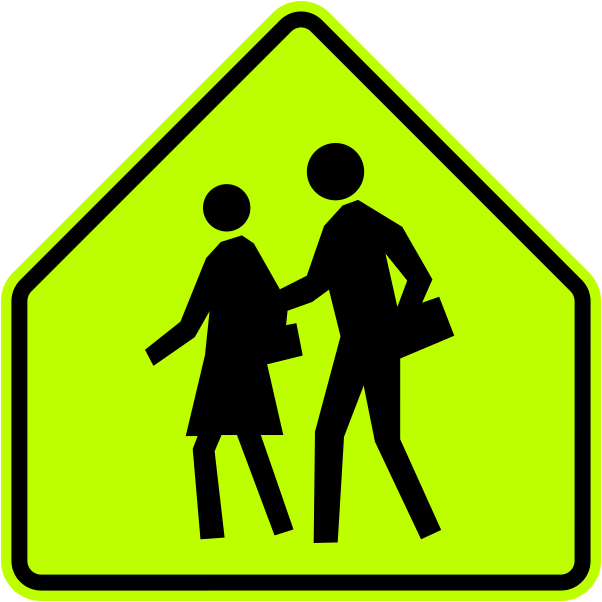
You pass this school sign with no speed sign attached. What does it require of you?
- A.Drive with caution because children may be walking or crossing; it sets no reduced speed limitAnswer
- B.Slow to 30 km/h at all times
- C.Stop and wait for a crossing guard
- D.Nothing, unless it is a school day
Explanation: A school sign without a speed sign marks a school area, not a school zone. It warns that children may be walking or crossing, so drive with caution; the speed change applies only where a maximum speed is posted.
8 of 28 · Speed limits
It is snowing heavily and you are driving exactly at the posted speed limit. Which statement is correct?
- A.You may be breaking the law: any speed that is unsafe for the conditions is illegalAnswer
- B.You are legal, because you are not over the limit
- C.You should speed up to keep up with the flow of traffic
- D.Speed limits are suspended in bad weather
Explanation: A speed limit is the maximum permitted when conditions are ideal, not a target. When the road, weather or traffic is poor, slow down: any speed unsafe for the current conditions is illegal.
9 of 28 · Speed limits
You are about to pass a tow truck stopped at the roadside with its lights flashing, in the lane right next to it. How fast may you go?
- A.60 km/h or the posted speed, whichever is lowerAnswer
- B.30 km/h, whatever the posted speed
- C.80 km/h or the posted speed, whichever is lower
- D.The posted speed; the rule is only for police vehicles
Explanation: Slow to 60 km/h or the posted speed, whichever is lower, when passing stopped emergency vehicles or tow trucks with lights flashing. The rule covers the lanes immediately next to them, and the speeding fine there is doubled.
10 of 28 · Speed limits
Under normal road and weather conditions, what is the minimum following distance behind the vehicle ahead?
- A.1 second
- B.2 secondsAnswer
- C.3 car lengths, whatever your speed
- D.5 seconds
Explanation: Stay at least 2 seconds behind the vehicle ahead in normal conditions, and increase the gap when conditions are less than ideal. Count the seconds from when the vehicle ahead passes a fixed object; the 2-second rule works at any speed.
11 of 28 · Speed limits
What minimum following distance is recommended for drivers of large vehicles such as motor homes?
- A.2 seconds
- B.3 seconds
- C.4 secondsAnswer
- D.8 seconds
Explanation: Large vehicles such as motor homes need more room to stop, so a minimum 4-second following distance is recommended instead of the usual 2 seconds.
12 of 28 · Speed limits
Which three distances add up to your total stopping distance?
- A.Perception distance + reaction distance + braking distanceAnswer
- B.Following distance + reaction distance + braking distance
- C.Reaction distance + braking distance + skid distance
- D.Perception distance + following distance + visual lead
Explanation: Total stopping distance is the distance travelled while you recognise the danger (perception), while you move your foot to the brake (reaction), and while the brakes bring the vehicle to a stop (braking).
13 of 28 · Speed limits
On average, how long does it take a driver to move their foot from the accelerator to the brake (reaction time)?
- A.About three-quarters of a secondAnswer
- B.About one-tenth of a second
- C.About 2 seconds
- D.About 5 seconds
Explanation: The average reaction time is about three-quarters of a second, and recognising the danger can take about the same again. Your vehicle keeps moving at full speed through both before braking even begins.
14 of 28 · Speed limits
What is the minimum distance you should keep when following an emergency vehicle with its siren or lights operating?
- A.50 metres
- B.100 metres
- C.150 metresAnswer
- D.300 metres
Explanation: Always yield to emergency vehicles with siren or lights operating, and keep a safe following distance of at least 150 metres behind them.
15 of 28 · Passing, lanes & freeways
What does a yellow line on the road tell you, and where should it be?
- A.Traffic on each side travels in opposite directions; it should always be on your leftAnswer
- B.Traffic on each side travels in the same direction; it should be on your right
- C.It marks the edge of the shoulder; it should be on your right
- D.It marks a lane reserved for buses
Explanation: Yellow lines separate traffic moving in opposite directions, and a yellow line should always be on the driver’s left. If it is on your right, you are going the wrong way.
16 of 28 · Passing, lanes & freeways
The centre of a two-lane road has a solid yellow line beside a broken yellow line. Who may pass?
- A.Only the driver with the broken line on their sideAnswer
- B.Only the driver with the solid line on their side
- C.Drivers in both directions
- D.No one, in either direction
Explanation: With a solid and a broken yellow line together, passing is permitted only for the driver who has the broken line on their side. The driver with the solid line on their side must not pass.
17 of 28 · Passing, lanes & freeways
In Alberta, what does a single solid yellow centre line mean for passing?
- A.Within an urban area you may pass across it when it is safe; elsewhere passing is not permittedAnswer
- B.Passing is never permitted anywhere
- C.Passing is permitted anywhere when it is safe
- D.Passing is permitted only on rural highways
Explanation: Alberta allows passing safely across a single solid yellow line within an urban area. In all other cases, single or double solid yellow lines mean passing is not permitted.
18 of 28 · Passing, lanes & freeways
What does a solid white line between two lanes going the same way mean?
- A.Lane changing is not permittedAnswer
- B.Lane changing is permitted with care
- C.Traffic on the other side travels in the opposite direction
- D.The lane ends ahead
Explanation: White lines separate traffic travelling in the same direction. A solid white line means lane changing is not permitted; a broken white line means it is.
19 of 28 · Passing, lanes & freeways
On a multi-lane highway, which lane should slower traffic use?
- A.The lane furthest to the right, unless it needs the left lane to turn leftAnswer
- B.The left lane, so it is not in the way of merging traffic
- C.Any lane, as long as it stays at the speed limit
- D.The emergency stopping lane
Explanation: Slower traffic should use the travel lane furthest to the right, unless it needs the left lane to turn left. That leaves the left lane free for other drivers to pass.
20 of 28 · Passing, lanes & freeways
You are driving in the right lane of a highway passing lane, and signs warn that it is ending. What happens next?
- A.You merge safely to the left, and drivers in the left lane cooperate to let you inAnswer
- B.Drivers in the left lane must move right to make room for you
- C.You have the right-of-way and may keep going
- D.You continue on the shoulder until there is a gap
Explanation: Slower vehicles move into the right lane of a passing lane so others can pass on the left. As it ends, drivers in the right lane must merge safely to the left, and drivers in the left lane must cooperate to let them merge.
21 of 28 · Passing, lanes & freeways
You are passing a vehicle on a two-lane highway. When may you start returning to your original lane?
- A.Once the passed vehicle is visible in your inside rear view mirror, after a right shoulder check and right signalAnswer
- B.As soon as your front bumper is past its front bumper
- C.When you see it in your right outside mirror only
- D.When its driver flashes the headlights at you
Explanation: Return only when the vehicle you passed is visible in your inside rear view mirror. Then shoulder check to the right, signal right, move back while keeping your speed, and turn the signal off.
22 of 28 · Passing, lanes & freeways
While passing another vehicle, may you go over the speed limit to finish the pass quickly?
- A.No: it is illegal to exceed the speed limit when passingAnswer
- B.Yes, by up to 20 km/h
- C.Yes, as long as the pass is safe
- D.Yes, but only on a two-lane highway
Explanation: Exceeding the speed limit when passing is illegal. If you cannot complete the pass within the limit, while passing is still permitted and with no oncoming traffic, do not start it.
23 of 28 · Passing, lanes & freeways
Another driver is passing you on a two-lane highway. How can you help?
- A.Stay in your lane and move to the right side of itAnswer
- B.Speed up so the pass takes less time
- C.Move to the left side of your lane so they can see you
- D.Drive onto the shoulder and stop
Explanation: When being passed, stay in your lane and move to its right side to give the passing driver a better view of the road ahead.
24 of 28 · Passing, lanes & freeways
On a multi-lane street, the vehicle in the lane beside you has stopped at a crosswalk to let a pedestrian cross. What should you do?
- A.Do not pass it; stop as wellAnswer
- B.Pass it carefully, since your lane is clear
- C.Sound your horn and continue
- D.Change into its lane and wait behind it
Explanation: You must not pass a vehicle that has stopped for a pedestrian. The stopped vehicle can hide the pedestrian from you until it is too late to stop.
25 of 28 · Passing, lanes & freeways
On a highway with one lane in each direction, where is passing unsafe and illegal?
- A.On a curveAnswer
- B.On a straight stretch with a broken yellow line and no oncoming traffic
- C.In a signed passing lane
- D.Where your side has the broken line of a solid-and-broken pair
Explanation: Do not pass on curves on highways with one lane in each direction: it is unsafe and illegal. For the same reason, never pass near the top of a hill, where you cannot see what is ahead.
26 of 28 · Passing, lanes & freeways
Traffic ahead on the highway is slow. May you use the emergency stopping lane (the shoulder) to get past?
- A.No: do not drive or pass in the emergency stopping laneAnswer
- B.Yes, if you signal and drive slowly
- C.Yes, to pass a vehicle turning left
- D.Yes, during rush hour only
Explanation: The emergency stopping lane is for drivers who must stop because of an urgent situation or a vehicle problem. Do not drive in it, and do not pass or help another vehicle pass you by using it.
27 of 28 · Passing, lanes & freeways
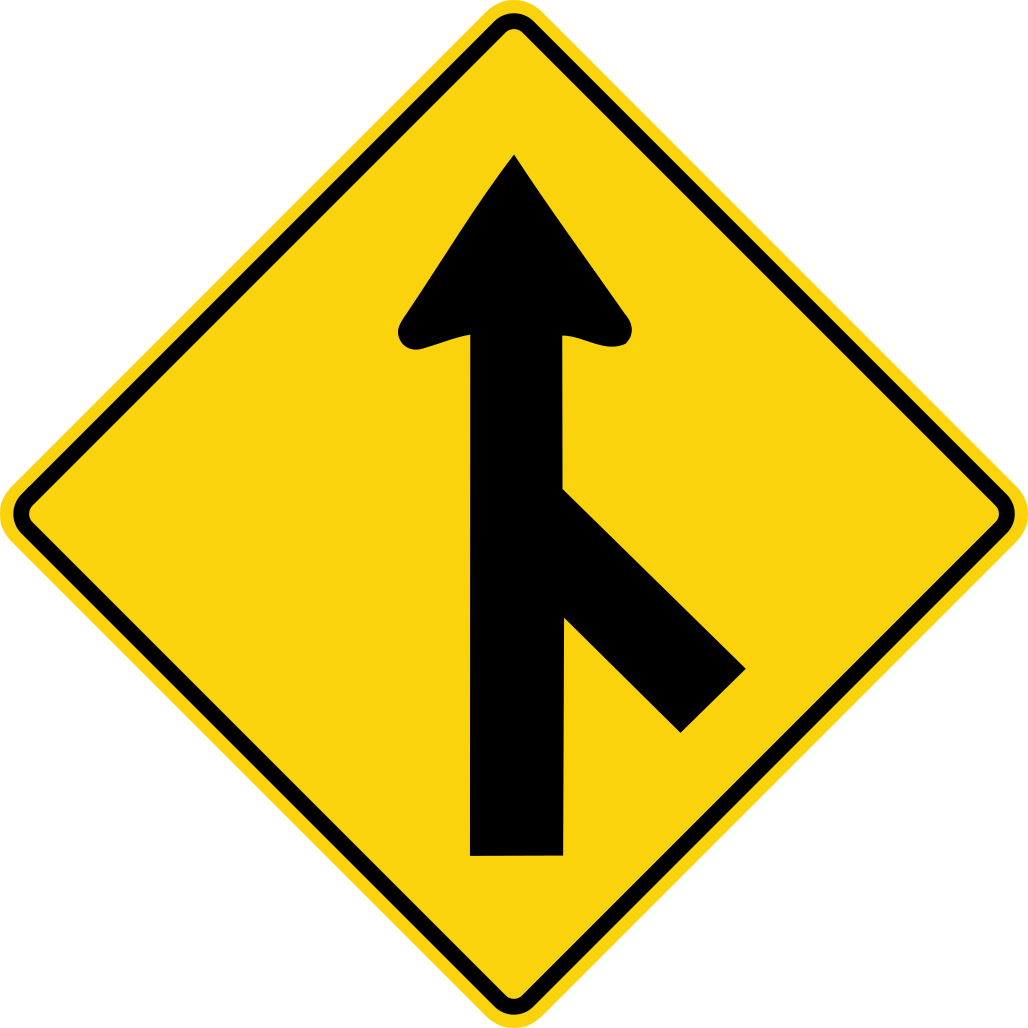
Where an on-ramp merges with a highway, who has the right-of-way?
- A.No one has it: merging is a shared responsibilityAnswer
- B.The merging vehicle
- C.Vehicles already on the highway, and the merging vehicle must stop if needed
- D.Whichever vehicle is larger
Explanation: Neither the merging vehicle nor the vehicles already on the highway have the right-of-way. The merging driver matches traffic speed in the acceleration lane, and drivers on the main road move left if safe or adjust to leave a gap.
28 of 28 · Passing, lanes & freeways
You realise too late that you have missed your exit on a highway. What should you do?
- A.Do not stop; continue to the next exit and plan a way back to your routeAnswer
- B.Stop on the shoulder and reverse back to the exit
- C.Brake hard and cut across to the exit ramp
- D.Make a U-turn across the median
Explanation: If you miss your exit, do not stop. Continue to the next exit and plan how to return to your route. Never stop and reverse on a highway, its emergency stopping lane or its shoulder.