1.Proactive driving: scanning, mirrors and space
- Proactive driving means anticipating hazards and acting before they turn into danger. Never assume other drivers will drive carefully or react correctly.
- Look at least 12 to 15 seconds ahead in urban areas and at least 20 to 25 seconds ahead in rural areas. This visual lead time gives you time to respond to hazards.
- Glance in your rear view mirrors every 8 to 12 seconds (about every block in the city) and whenever you expect to slow down or stop. Check your speedometer too.
- Set the outside mirrors to reduce blind spots, so that your own vehicle just shows in the inner edge of each side mirror. Mirrors still miss areas: do a shoulder check to make sure your blind spots are clear.
- Watch for fixed hazards, such as curves, hills, hidden driveways, intersections and merging roads, and for changing ones, such as pedestrians, left-turning vehicles, icy patches and "stale" green lights. Always plan an escape route.
- Keep a space cushion ahead, behind and to both sides, so you can stop safely or steer around a hazard. If someone tailgates you, slow down slightly, if it is safe, to encourage them to pass; if they do not, leave more room in front of you.
- When you stop behind another vehicle in traffic, leave enough room to pull into another lane without reversing. If you are hit from behind, you are less likely to be pushed into the car ahead, and you can move away from a vehicle skidding towards you.
Official source: Responsible driving ↗ · Basics of driving ↗
2.Following distance and stopping
- Under normal road and weather conditions, stay at least 2 seconds behind the vehicle ahead. The rule works at any speed; when conditions are less than ideal, leave more room.
- To check your gap, start counting 2 seconds when the vehicle ahead passes a fixed object such as a road marking or a shadow. If your front bumper reaches the object before you finish, you are too close: slow down and count again.
- Drivers of large vehicles, such as motor homes, are advised to keep a following distance of at least 4 seconds.
- Total stopping distance is the distance you travel while perceiving the danger, plus the distance while reacting, plus the braking distance. The guide's chart gives averages on smooth, dry pavement.
- Perception time is about three-quarters of a second, and less experienced drivers often take longer. Average reaction time is another three-quarters of a second.
- Road and weather conditions lengthen stopping distance. Factors you control include how well you scan, your decisions, your alertness and fatigue, alcohol or drug use, your speed, and the condition of your brakes and tires.
- Begin braking early, and lift off the accelerator before you brake. To finish smoothly, ease off the brake pedal slightly and reapply it just before the vehicle stops.
Official source: Responsible driving ↗ · Basics of driving ↗
3.Emergency braking, skids and loss of control
- In an emergency stop, the aim is to stop as quickly as possible without losing control of the vehicle.
- With ABS, press the brake pedal with steady, firm pressure; do not pump it or let it up, and look and steer where you want to go. ABS lets you steer while braking hard, and you will feel it as a vibration in the pedal.
- Without ABS, hard braking can lock the wheels and take away your steering. Use threshold braking: press firmly to just before the wheels lock; if they lock, ease off slightly to regain steering, then press firmly again.
- Most skids come from driver error: going too fast on ice, snow, rain, mud, sand or gravel, turning the wheel too sharply or too far for your speed, braking too hard or accelerating too quickly.
- Plan ahead so you do not have to brake or steer suddenly, drive smoothly, and slow down on unfamiliar roads or in poor conditions.
- If you start to skid, keep your foot off the brake. Look and steer where you want the front of the vehicle to go, keep the tires pointed along the centre of your lane, and avoid large steering corrections.
- If you run off the pavement, grip the wheel firmly, ease off the gas and do not jerk back onto the road. Avoid braking, or brake gently; check for traffic, then return gradually and straighten up in your lane.
| Skid | Cause | What to do |
|---|---|---|
| Power (acceleration) skid | Accelerating too quickly, so the wheels spin | Lift off the gas, steer where you want to go without over-correcting, then accelerate gently |
| Cornering skid | Going too fast in a turn, so the vehicle slides sideways | Lift off the gas, do not brake, look and steer where you want to go |
| Braking skid (no ABS) | Braking too firmly, so the wheels lock | Take your foot off the brake so the wheels roll and steering returns; brake again firmly without locking |
Official source: Emergency situations ↗
4.Night, poor visibility and slippery roads
- Turn your headlights on at night or at any time you cannot clearly see 150 metres ahead. Daytime running lights are not enough: they are too dim, and your tail lights and instrument lights stay off.
- Use low beams within 300 metres of an oncoming vehicle, even on a divided highway, and when following within 150 metres of another vehicle. Do not look straight into oncoming headlights: look slightly down and to the right edge of your lane.
- Do not overdrive your headlights: drive at a speed that lets you stop within the distance they light up. If glare from the sun or other lights makes the road hard to see, slow down, and keep your windows clean inside and out.
- In smoke, fog or rain, use low beams: high beams reflect back at you as glare. If visibility becomes too poor to drive safely, pull well off the road, turn on your hazard lights and wait; if there is no safe place to park, get everyone to a safe spot away from the vehicle.
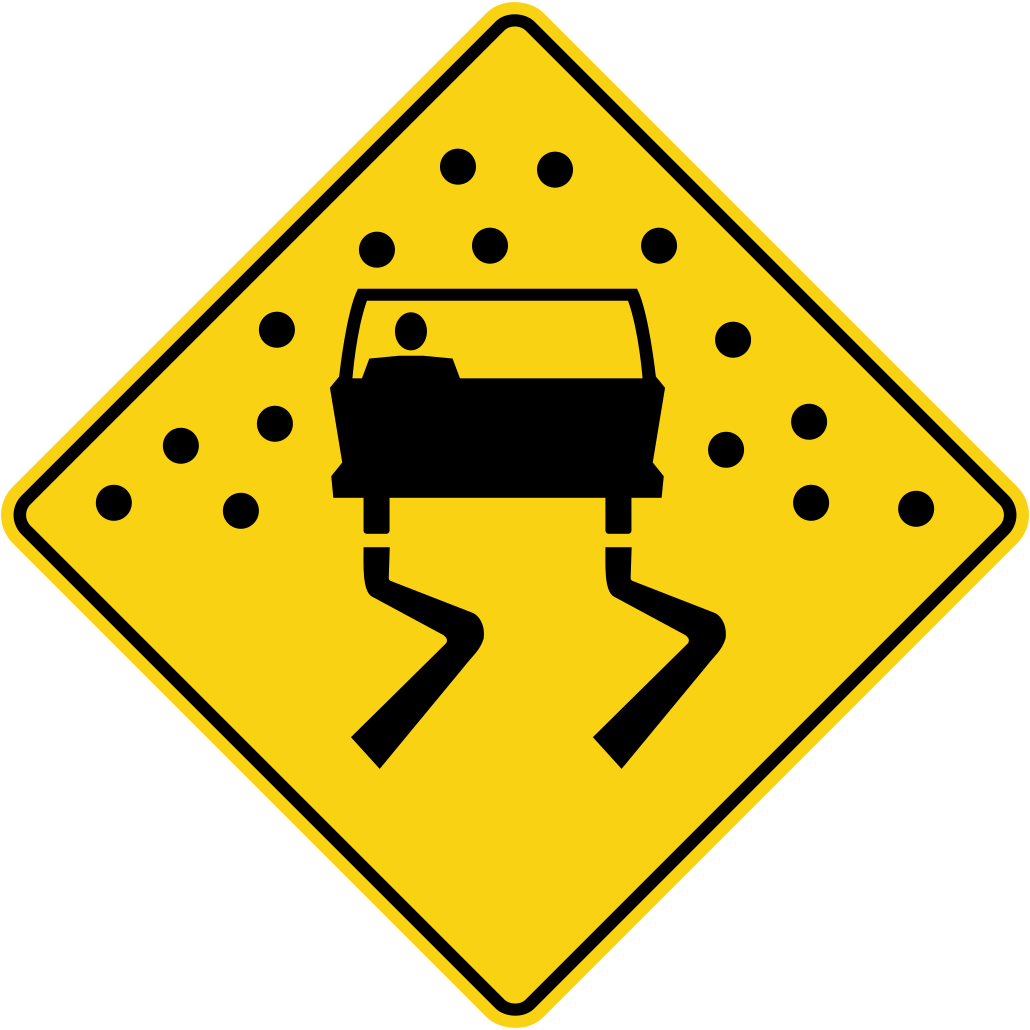
- On wet roads your tires can lose contact with the surface (hydroplaning). If this happens, do not brake: ease off the accelerator to slow down, and look and steer where you want the front of the vehicle to go.
- Black ice is often invisible. If the asphalt looks shiny and black instead of grey-white, slow down without braking. Shaded areas, bridge decks, overpasses and intersections can be icy when the rest of the road is not.
- In winter, reducing speed matters most: allow more time and distance to stop and start. Do not use cruise control on poor roads — on ice it keeps accelerating and you can lose control. Have the vehicle serviced before winter.
Signs in this section
Official source: Emergency situations ↗
5.Breakdowns, mechanical failures and emergency supplies
- If a mechanical problem forces you to stop, change lanes safely and park in a safe place if you can — never on a bridge or in a tunnel. Turn on your hazard lights if the vehicle is left somewhere dangerous, and raise the hood.
- On a highway or in a risky spot, place reflective triangles behind the vehicle about 10 to 20 metres apart. Do not attempt repairs beside crowded or fast-moving highways; if the situation is dangerous, everyone should wait behind and well away from the vehicle.
- If the brake warning light comes on and the park brake is released, move to the side of the road as soon as it is safe. If power brakes fail because the engine stops, push the pedal harder with steady pressure.
- If the brakes fail and your wheels are straight, use the park brake carefully to slow down; shifting to a lower gear may help you stop. Do not drive again until the brakes have been checked and repaired.
- A flat front tire pulls the vehicle hard towards that side; a flat rear tire can make it weave. Do not brake right away: lift off the gas, hold the wheel firmly and steer straight, brake gently once you have control, then pull off the road and turn on your hazard lights.
- If both headlights fail, turn on your hazard lights and switch the headlights off and on. If they stay off, slow down and park safely at the edge of the road. If the power steering fails, you can still steer, but it takes extra effort.
- If you are stranded off the highway in a safe place, it is usually safer to stay with the vehicle. Run the engine only enough to stay warm, and open a window slightly: carbon monoxide from a leaky exhaust has no colour, smell or taste.
| Keep in the car at all times | Add for winter |
|---|---|
| Flashlight with extra batteries | Blankets and extra clothing |
| First aid kit | Sand or road salt, and a shovel |
| Reflective triangles or other approved warning devices | A heat source: candle, matches and a deep can to hold the candle |
| Booster cables and a tow rope | Ice scraper and snow brush |
| Jack and an inflated spare tire; spare headlight bulbs | Tire chains |
| Non-perishable food | — |
Official source: Emergency situations ↗
6.Collisions and animals on the road
- If you are the first to reach a collision, stop in a safe place away from it, help if you can, and protect the scene with hazard lights and reflective triangles. When you call police or emergency medical services, be precise about the injured and the location.
- If you are involved, help where you can, protect the scene and call for emergency help if needed. Exchange names, contact information and insurance details with the other drivers, and write down the names and contact information of all witnesses.
- Do not discuss who was at fault. Note the time, location, weather and any other important details, and notify your insurance company as soon as possible.
- You must report a collision to the police if anyone is injured or killed, if total damage is over $5000, or if a traffic control device, parking meter or public property is damaged. The damage threshold can change, so confirm it on alberta.ca.
- If police are called to the scene, every driver involved must stay there.
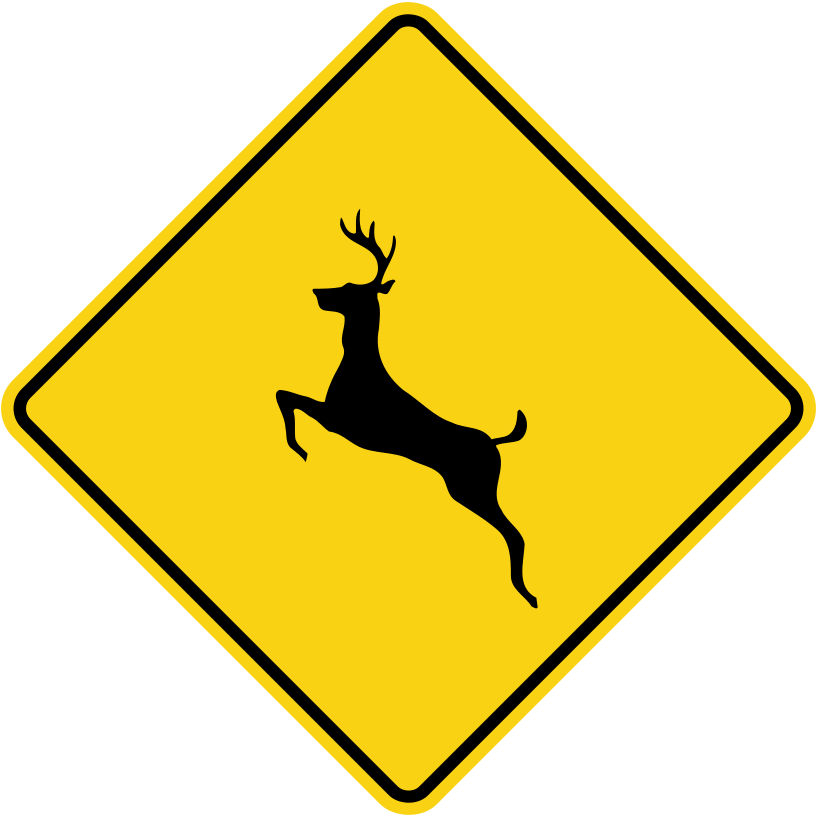
- To avoid hitting an animal, slow down and scan the roadsides, especially near wildlife warning signs and at dusk and dawn. Spots of light near the road at night may be your headlights reflecting in an animal's eyes, and where there is one animal there may be more.
- If an animal suddenly appears in front of you, brake hard and be ready to swerve, choosing an escape route away from oncoming traffic.
Signs in this section
Official source: Emergency situations ↗
7.Fit to drive: fatigue, impairment and distraction
- Alcohol, drugs and some prescription or over-the-counter medications can impair your judgement and reaction time. Stress, fatigue and lack of sleep also reduce your ability to drive. Impairment begins with the first drink or drug use.
- Fatigue can come from lack of sleep or rest, emotional stress, boredom, long hours at the wheel, physical activity, illness or eye strain. Overeating, alcohol or drugs, or even a warm, comfortable vehicle can make it worse.
- Fatigue slows your reactions and weakens judgement and decision-making, leading to errors such as drifting off the road, into another lane or into oncoming traffic — often without you realizing the danger.
- To stay alert, start the trip well rested, keep the vehicle comfortably cool and well ventilated, keep your eyes moving and check your gauges, and wear sunglasses on bright days. If you feel tired, stop for a rest and walk around the vehicle.
- Medications can cause drowsiness or dizziness. Ask your doctor and pharmacist, know the effects of everything you take before you drive, and know what happens if you combine it with alcohol or drugs.
- Alberta's distracted driving law bans using a hand-held phone, texting or e-mailing, using electronic devices, entering information on a GPS, reading, writing and personal grooming while driving — even when stopped at a red light. The penalty is a $390 fine and 3 demerit points.
- The guide warns that even hands-free calls take your attention from driving: to call or text, stop in a safe, legal place. Set up electronics before you leave, and stay calm — avoid emotional conversations with passengers.
Official source: Driving within the law ↗ · Distracted driving ↗ · Responsible driving ↗
8.Fuel-efficient driving and fuelling safety
- Speed costs fuel: every 10 km/h above 90 km/h burns about 10% more.
- Accelerate gradually and keep a steady speed: rapid acceleration and speed changes can raise fuel use by as much as 40%. Cruise control can help hold a steady speed on the highway.
- Idling wastes fuel: 10 seconds of idling can use more fuel than restarting the engine, so turn it off if you will be parked for more than 10 seconds.
- In winter, idling does not warm the tires or steering, which only warm up as you drive. Put the block heater on a timer to start 2 hours before you leave, and do not leave it on overnight.
- Keep the vehicle maintained and the tires properly inflated, use air conditioning sparingly, remove extra weight, and plan trips to combine errands and avoid rush hour.
- When fuelling, turn the ignition off, do not smoke or use a phone, and stay by the nozzle: static electricity could ignite gasoline vapours. Never prop the nozzle open, do not overfill, and set extra fuel containers on the ground to fill them.
| Habit or condition | Effect on fuel |
|---|---|
| Every 10 km/h above 90 km/h | About 10% more fuel |
| Rapid acceleration and speed changes | Up to 40% more fuel |
| Poorly tuned engine | Up to 50% more fuel |
| Clogged air filter | 10% lower fuel efficiency |
| Under-inflated tires | About 5% more fuel, more tire wear, less traction |
| Air conditioning | 10% to 25% more in stop-and-go traffic; 3% to 4% more at highway speeds |
| Proper use of a block heater | Up to 10% better overall fuel economy |
Official source: Responsible driving ↗