Practice session
Speed limits
Loading…
Every question on this page
The whole pool, with the answer and the explanation for each one. Practise first, then read through anything you were unsure of.
Show all 14 questions with answers
1 of 14 · Speed limits
Unless a sign shows otherwise, what is the maximum speed on a roadway within an urban area?
- A.40 km/h
- B.50 km/hAnswer
- C.60 km/h
- D.70 km/h
Explanation: The default limit on a roadway within an urban area is 50 km/h unless otherwise posted. Municipalities may set different limits by bylaw, so always watch the signs.
2 of 14 · Speed limits
Unless otherwise posted, what is the maximum speed on a provincial highway outside an urban area?
- A.80 km/h
- B.90 km/h
- C.100 km/hAnswer
- D.110 km/h
Explanation: A provincial highway outside an urban area has a maximum of 100 km/h unless another limit is posted. Inside a city, the same highway drops to 80 km/h unless posted otherwise.
3 of 14 · Speed limits
You are on a rural roadway that is not a provincial highway, and no speed sign is posted. What is the maximum speed?
- A.60 km/h
- B.80 km/hAnswer
- C.90 km/h
- D.100 km/h
Explanation: A roadway outside an urban area has a maximum of 80 km/h unless otherwise posted. The 100 km/h default applies only to provincial highways, which carry a numbered route marker.
4 of 14 · Speed limits
Unless another speed is posted, what is the speed limit in this zone while it is in effect?
- A.20 km/h
- B.30 km/hAnswer
- C.40 km/h
- D.50 km/h
Explanation: A school sign with a maximum speed marks a school zone. The limit in both urban and rural school zones is 30 km/h unless otherwise posted, and passing a vehicle going the same way is not allowed while the zone is in effect.
5 of 14 · Speed limits
Unless a municipality posts different times, when is a school zone in effect?
- A.On school days only: 8:00 a.m. to 9:30 a.m., 11:30 a.m. to 1:30 p.m. and 3:00 p.m. to 4:30 p.m.Answer
- B.Every day, from 8:30 a.m. until 1 hour after sunset
- C.On school days, from 7:00 a.m. to 6:00 p.m.
- D.At all times, 24 hours a day
Explanation: School zones apply on school days only, from 8:00 a.m. to 9:30 a.m., 11:30 a.m. to 1:30 p.m. and 3:00 p.m. to 4:30 p.m. If a municipality sets other times by bylaw, they are posted beneath the school sign.
6 of 14 · Speed limits
Unless other times are posted, when is this zone in effect?
- A.Every day, from 8:30 a.m. until 1 hour after sunsetAnswer
- B.On school days only, from 8:00 a.m. to 4:30 p.m.
- C.Every day, from sunrise to sunset
- D.Only in summer, from 9:00 a.m. to 9:00 p.m.
Explanation: Unlike school zones, playground zones apply every day, weekends included, from 8:30 a.m. until 1 hour after sunset. Municipal bylaws may set other times, which are posted beneath the playground sign.
7 of 14 · Speed limits
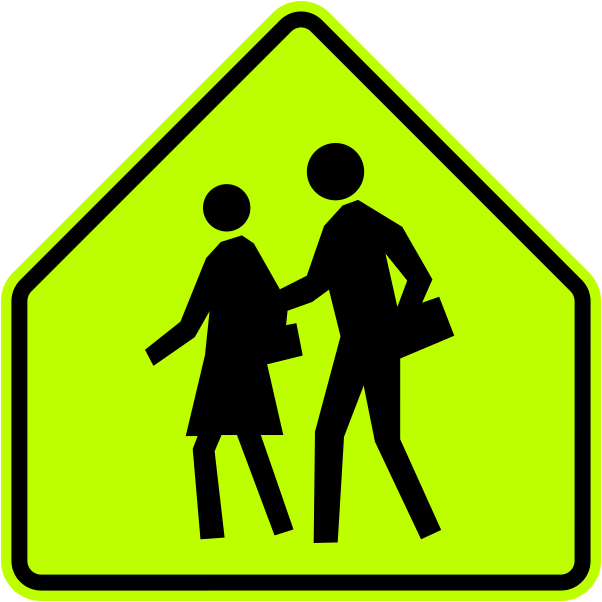
You pass this school sign with no speed sign attached. What does it require of you?
- A.Drive with caution because children may be walking or crossing; it sets no reduced speed limitAnswer
- B.Slow to 30 km/h at all times
- C.Stop and wait for a crossing guard
- D.Nothing, unless it is a school day
Explanation: A school sign without a speed sign marks a school area, not a school zone. It warns that children may be walking or crossing, so drive with caution; the speed change applies only where a maximum speed is posted.
8 of 14 · Speed limits
It is snowing heavily and you are driving exactly at the posted speed limit. Which statement is correct?
- A.You may be breaking the law: any speed that is unsafe for the conditions is illegalAnswer
- B.You are legal, because you are not over the limit
- C.You should speed up to keep up with the flow of traffic
- D.Speed limits are suspended in bad weather
Explanation: A speed limit is the maximum permitted when conditions are ideal, not a target. When the road, weather or traffic is poor, slow down: any speed unsafe for the current conditions is illegal.
9 of 14 · Speed limits
You are about to pass a tow truck stopped at the roadside with its lights flashing, in the lane right next to it. How fast may you go?
- A.60 km/h or the posted speed, whichever is lowerAnswer
- B.30 km/h, whatever the posted speed
- C.80 km/h or the posted speed, whichever is lower
- D.The posted speed; the rule is only for police vehicles
Explanation: Slow to 60 km/h or the posted speed, whichever is lower, when passing stopped emergency vehicles or tow trucks with lights flashing. The rule covers the lanes immediately next to them, and the speeding fine there is doubled.
10 of 14 · Speed limits
Under normal road and weather conditions, what is the minimum following distance behind the vehicle ahead?
- A.1 second
- B.2 secondsAnswer
- C.3 car lengths, whatever your speed
- D.5 seconds
Explanation: Stay at least 2 seconds behind the vehicle ahead in normal conditions, and increase the gap when conditions are less than ideal. Count the seconds from when the vehicle ahead passes a fixed object; the 2-second rule works at any speed.
11 of 14 · Speed limits
What minimum following distance is recommended for drivers of large vehicles such as motor homes?
- A.2 seconds
- B.3 seconds
- C.4 secondsAnswer
- D.8 seconds
Explanation: Large vehicles such as motor homes need more room to stop, so a minimum 4-second following distance is recommended instead of the usual 2 seconds.
12 of 14 · Speed limits
Which three distances add up to your total stopping distance?
- A.Perception distance + reaction distance + braking distanceAnswer
- B.Following distance + reaction distance + braking distance
- C.Reaction distance + braking distance + skid distance
- D.Perception distance + following distance + visual lead
Explanation: Total stopping distance is the distance travelled while you recognise the danger (perception), while you move your foot to the brake (reaction), and while the brakes bring the vehicle to a stop (braking).
13 of 14 · Speed limits
On average, how long does it take a driver to move their foot from the accelerator to the brake (reaction time)?
- A.About three-quarters of a secondAnswer
- B.About one-tenth of a second
- C.About 2 seconds
- D.About 5 seconds
Explanation: The average reaction time is about three-quarters of a second, and recognising the danger can take about the same again. Your vehicle keeps moving at full speed through both before braking even begins.
14 of 14 · Speed limits
What is the minimum distance you should keep when following an emergency vehicle with its siren or lights operating?
- A.50 metres
- B.100 metres
- C.150 metresAnswer
- D.300 metres
Explanation: Always yield to emergency vehicles with siren or lights operating, and keep a safe following distance of at least 150 metres behind them.