Practice session
Turning & signalling
Loading…
Every question on this page
The whole pool, with the answer and the explanation for each one. Practise first, then read through anything you were unsure of.
Show all 14 questions with answers
1 of 14 · Turning & signalling
How far before an intersection should you be in the proper lane for your turn?
- A.At least 5 metres
- B.At least 15 metresAnswer
- C.At least 50 metres
- D.At least 150 metres
Explanation: Prepare for a turn well in advance: check your mirrors, shoulder check, signal, and be in the proper turning lane at least 15 metres before the intersection.
2 of 14 · Turning & signalling
When turning right from a two-way road onto another two-way road, how close to the curb should you stay?
- A.Not more than one metre from the curb or road edgeAnswer
- B.At least 3 metres from the curb
- C.In the middle of the road, to swing wide
- D.Next to the centre line
Explanation: Stay centred in the turning lane, not more than one metre from the curb or road edge, before, during and after the turn.
3 of 14 · Turning & signalling
You want to turn right and face this light. No sign prohibits the turn. What must you do?
- A.Stop completely at the stop line or crosswalk, then turn when it is safeAnswer
- B.Slow down and turn without stopping if the way is clear
- C.Wait for the light to turn green
- D.Turn right only if a green arrow also appears
Explanation: Unless a sign prohibits it, you may turn right on a red light after coming to a complete stop at the stop line or crosswalk. Yield to pedestrians and traffic before you go.
4 of 14 · Turning & signalling
Which of these is the correct way to complete a turn?
- A.Stay in one lane, without swinging wide across 2 lanesAnswer
- B.Swing wide into 2 lanes so the turn is smoother
- C.Finish in whichever lane has the least traffic
- D.Cut the corner across the curb lane
Explanation: Do not turn wide and occupy 2 lanes when turning. Turn into the proper lane, then change lanes later with a mirror check, shoulder check and signal if you need to.
5 of 14 · Turning & signalling
You are turning left from a two-way road onto another two-way road. Which lanes should you use?
- A.From the lane nearest and to the right of the yellow line, into the lane nearest and to the right of the yellow lineAnswer
- B.From the curb lane, into the curb lane
- C.From the lane nearest the yellow line, into any lane that is free
- D.From any lane, as long as you signal
Explanation: Turn from the lane nearest and to the right of the yellow line into the lane nearest and to the right of the yellow line. Yield to oncoming traffic and to pedestrians crossing on your left.
6 of 14 · Turning & signalling
You are turning left from a two-way road onto a one-way road. Which lane should you turn into?
- A.The first available lane on the left side of the roadAnswer
- B.The lane farthest to the right
- C.The middle lane
- D.Any lane, since all traffic goes the same way
Explanation: Turn from the lane nearest the yellow line into the first available lane on the left side of the one-way road. Yield to oncoming traffic and pedestrians crossing to your left.
7 of 14 · Turning & signalling
You have to stop in the intersection while waiting to complete a left turn. How should your front wheels be pointed?
- A.Straight aheadAnswer
- B.Turned to the left, ready to go
- C.Turned to the right
- D.It does not matter
Explanation: Stay to the right of the yellow line and keep your front wheels pointed straight ahead. If you are hit from behind, your car will not be pushed into oncoming traffic.
8 of 14 · Turning & signalling
When may you turn left on a red light in Alberta?
- A.From a one-way road onto another one-way road, after a complete stop, if no sign prohibits itAnswer
- B.From any road, after a complete stop
- C.From a two-way road onto a one-way road, without stopping
- D.Never
Explanation: If no sign prohibits it, you may turn left on red from a one-way road onto another one-way road after a complete stop at the stop line or crosswalk, when the turn can be done safely. Yield to pedestrians crossing to your left.
9 of 14 · Turning & signalling
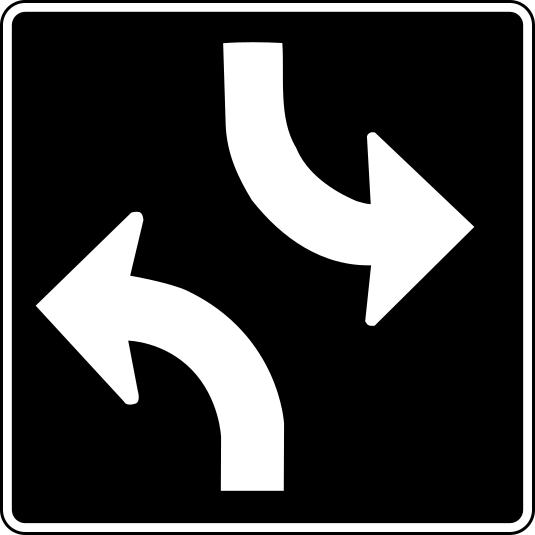
How should you use the two-way left turn lane shown by this sign?
- A.Cross the solid yellow line to enter it close to where you will turn leftAnswer
- B.Use it as a passing lane when traffic is slow
- C.Enter it as early as possible and drive in it for several blocks
- D.Never cross the solid yellow line to enter it
Explanation: Vehicles from both directions share this centre lane to turn left. You may cross the solid yellow line to enter it, but enter only close to where you will turn and watch for oncoming vehicles using the same lane.
10 of 14 · Turning & signalling
At an intersection marked for dual left turns, how do you make your turn?
- A.Approach in one of the marked lanes and turn into the corresponding laneAnswer
- B.Turn into whichever lane is emptier
- C.Change lanes during the turn if needed
- D.Swing wide to leave room for the vehicle beside you
Explanation: Where dual lane turns are marked, stay in your lane from start to finish and turn into the matching lane. Never swing wide or change lanes, because another vehicle may be turning beside you.
11 of 14 · Turning & signalling
May you make a U-turn at an intersection controlled by traffic lights?
- A.No, unless a traffic control device permits itAnswer
- B.Yes, whenever the light is green
- C.Yes, but only on a red light after stopping
- D.Yes, if no other vehicles are in sight
Explanation: U-turns are not permitted at an intersection controlled by traffic lights unless a traffic control device permits them, and never where a sign prohibits them. Any U-turn must also be safe.
12 of 14 · Turning & signalling
In an urban area, which of these U-turns is not permitted, even if it would be safe?
- A.A U-turn on a roadway between intersectionsAnswer
- B.A U-turn at an uncontrolled intersection with a clear view, where no sign prohibits it
- C.A U-turn at a stop-sign intersection where no sign prohibits it
- D.A U-turn at a signal-controlled intersection where a sign permits it
Explanation: In urban areas U-turns are not allowed on a roadway between intersections, at an alley intersection, or at an intersection with an access to a parking lot open to the public.
13 of 14 · Turning & signalling
Outside urban areas, a U-turn is also not permitted near the crest of a hill where another driver approaching within what distance cannot see you?
- A.50 metres
- B.100 metres
- C.150 metresAnswer
- D.300 metres
Explanation: On rural roads, do not make a U-turn on a curve, or on the approach to or near the crest of a hill where a driver within 150 metres, from either direction, cannot see you.
14 of 14 · Turning & signalling
You have driven slightly past the street you wanted. May you back up into the intersection to make the turn?
- A.No: it is illegal to reverse into an intersection or a crosswalkAnswer
- B.Yes, if you use your hazard lights
- C.Yes, if no pedestrians are in the crosswalk
- D.Yes, as long as you back up slowly
Explanation: Moving your vehicle in reverse into an intersection or a crosswalk is illegal. Continue ahead and find a legal, safe way to get back to your route.