Practice session
Right-of-way & intersections
Loading…
Every question on this page
The whole pool, with the answer and the explanation for each one. Practise first, then read through anything you were unsure of.
Show all 20 questions with answers
1 of 20 · Right-of-way & intersections
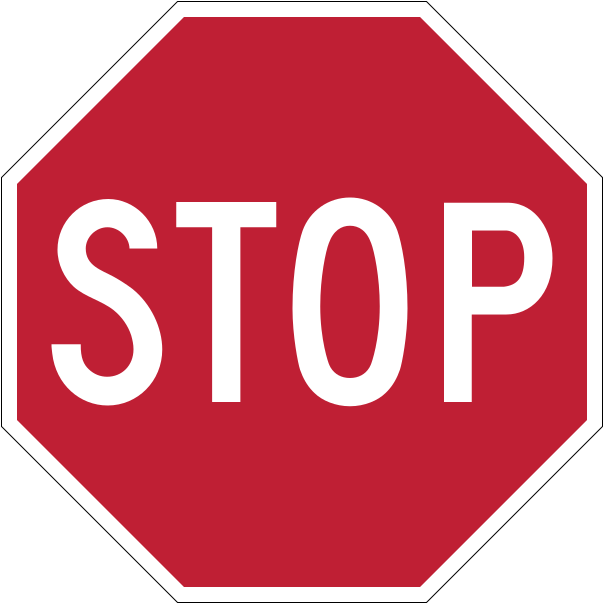
You come to this sign and a stop line is painted on the road. Where must you stop?
- A.Before the stop lineAnswer
- B.With your front bumper over the stop line
- C.At the edge of the cross street, past the line
- D.Wherever you can see best, even past the line
Explanation: Where a stop line is marked, make a complete stop before it. Then give pedestrians and traffic the right-of-way before moving forward.
2 of 20 · Right-of-way & intersections
At a stop sign with no stop line and no marked crosswalk, where must you stop?
- A.Within 3 metres of the intersecting roadwayAnswer
- B.Within 10 metres of the intersecting roadway
- C.Exactly 15 metres before the intersection
- D.Inside the intersection, where you can see both ways
Explanation: With no stop line or marked crosswalk, stop within 3 metres of the intersecting roadway, at a point where you will not interfere with pedestrians who are crossing or about to cross.
3 of 20 · Right-of-way & intersections
At a four-way stop, which vehicle should go first?
- A.The vehicle that arrived and stopped firstAnswer
- B.The vehicle on the busier road
- C.The largest vehicle
- D.The vehicle turning left
Explanation: Three- and four-way stops are "courtesy corners": every vehicle stops, and the one that arrived first proceeds first. Go only when it is safe.
4 of 20 · Right-of-way & intersections
Two vehicles arrive at a four-way stop at the same time. Which one should go first?
- A.The vehicle on the rightAnswer
- B.The vehicle on the left
- C.The vehicle going straight, whatever side it is on
- D.The driver who signals first
Explanation: When two vehicles arrive at the same time, courtesy lets the vehicle on the right proceed first. Always make sure the other driver is yielding before you move.
5 of 20 · Right-of-way & intersections
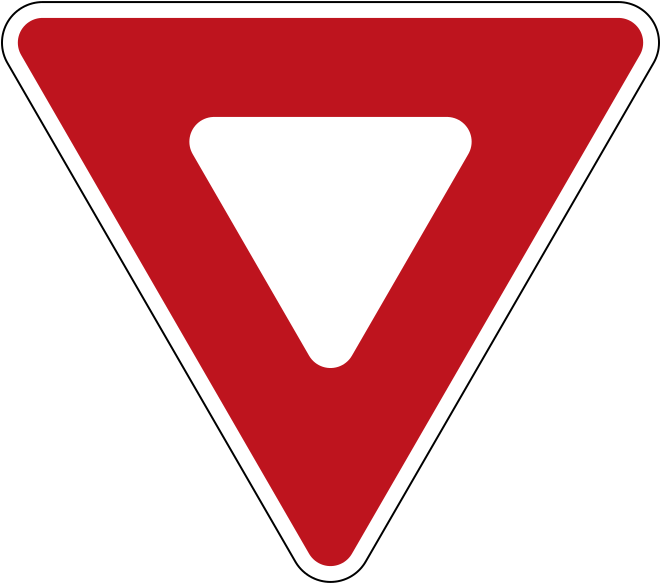
You approach this sign and there are no pedestrians or vehicles you need to yield to. What may you do?
- A.Proceed through without coming to a complete stopAnswer
- B.Come to a complete stop anyway, as at a stop sign
- C.Speed up to merge ahead of any traffic that may come
- D.Stop and wait for a gap of at least 10 seconds
Explanation: A yield sign means slow down and be prepared to stop for traffic or pedestrians. If there is no one you must yield to, you may go through without a full stop.
6 of 20 · Right-of-way & intersections
At an intersection with no signs and no traffic lights, who must you yield to?
- A.A vehicle approaching on your rightAnswer
- B.A vehicle approaching on your left
- C.Nobody; the first vehicle to enter has the right-of-way
- D.Only vehicles larger than yours
Explanation: At an uncontrolled intersection you must yield to a vehicle on your right. Slow down enough to stop easily, and check both left and right because fences, trees or parked cars may block your view.
7 of 20 · Right-of-way & intersections
At a T intersection with no signs or signals, you are driving straight through. A car is waiting on the road that ends at the intersection, on your right. Who has the right-of-way?
- A.The car on your rightAnswer
- B.You, because you are on the through road
- C.You, because you are going straight
- D.Whichever driver sounds the horn first
Explanation: An uncontrolled T intersection follows the same rule: the driver on the right has the right-of-way. The driver going straight through must not assume the road is theirs.
8 of 20 · Right-of-way & intersections
Two cars approach the same crossing aisle in a parking lot with no signs. Which rule applies?
- A.The normal right-of-way rules for intersections without signs or signalsAnswer
- B.No rules apply, because a parking lot is private property
- C.The car heading toward the exit goes first
- D.The larger vehicle goes first
Explanation: Parking lots contain intersections without signs or signals, and the ordinary right-of-way rules apply there, including yielding to the vehicle on your right.
9 of 20 · Right-of-way & intersections
You are driving out of a driveway that crosses a sidewalk onto a main street. What must you do?
- A.Stop before the sidewalk, stop again before the street, and yield to pedestriansAnswer
- B.Slow down and merge without stopping if the street looks clear
- C.Stop only if a pedestrian is already on the sidewalk
- D.Sound the horn to warn pedestrians, then drive out
Explanation: When leaving a service road, alley, parking lot or driveway, stop before any sidewalk crossing, stop before entering the main street, and yield to pedestrians.
10 of 20 · Right-of-way & intersections
Your light is green, but traffic is backed up and there is no room for your car on the far side of the intersection. What should you do?
- A.Wait before the intersection until you can clear it and the far crosswalk completelyAnswer
- B.Enter the intersection, since the light is green
- C.Stop on the far crosswalk so you are ready to move
- D.Enter the intersection and turn on your hazard lights
Explanation: Do not enter an intersection until you can clear it completely, including the crosswalk on the other side. A car stuck in the middle blocks cross traffic and pedestrians when the light changes.
11 of 20 · Right-of-way & intersections
You have the right-of-way, but another driver starts to pull out in front of you. What is your duty?
- A.Do everything you can to prevent a collisionAnswer
- B.Keep going: the other driver must yield
- C.Sound your horn and hold your speed
- D.Nothing: a collision would be entirely the other driver’s fault
Explanation: Right-of-way rules say who should yield, but even with the right-of-way you are still responsible for doing everything you can to prevent a collision.
12 of 20 · Right-of-way & intersections
A police officer directing traffic waves you through an intersection while your light is red. What should you do?
- A.Follow the officer's directionAnswer
- B.Wait for the light to turn green
- C.Follow whichever you saw first
- D.Turn right instead, since that is allowed on red
Explanation: Directions given by a peace officer or police officer override traffic signs and signals, so you follow the officer's signal.
13 of 20 · Right-of-way & intersections
A pedestrian has stepped into a marked crosswalk ahead of you. What must you do?
- A.Yield the right-of-way to the pedestrianAnswer
- B.Continue if the pedestrian is not yet in your lane
- C.Sound your horn so the pedestrian waits
- D.Yield only if a traffic light controls the crosswalk
Explanation: Once a pedestrian has entered a marked or unmarked crosswalk, you must yield the right-of-way and let them finish crossing.
14 of 20 · Right-of-way & intersections
On a multi-lane road, how far back should you stop when stopping for a pedestrian at a crosswalk?
- A.About 2 to 3 car lengths back, so drivers in other lanes can see the pedestrianAnswer
- B.As close to the crosswalk as possible
- C.About 10 car lengths back
- D.With your front wheels on the crosswalk line
Explanation: Stop about 2 to 3 car lengths before the crosswalk. That leaves a clear sight line so traffic in other lanes can see the pedestrian and has time to stop.
15 of 20 · Right-of-way & intersections
An intersection has no painted crosswalk lines. Is there a crosswalk there?
- A.Yes: every intersection has crosswalks, marked or unmarkedAnswer
- B.No: a crosswalk exists only where lines are painted
- C.Only if a pedestrian crossing sign is posted
- D.Only in urban areas with sidewalks
Explanation: All intersections have crosswalks, which may be marked or unmarked. Treat an unmarked crosswalk exactly like a painted one, and never pass a vehicle that has stopped for a pedestrian.
16 of 20 · Right-of-way & intersections
In a city, a pedestrian at the curb raises an arm at a right angle and points to the opposite curb. What does this mean?
- A.They intend to cross; stop safely before the crosswalk and let them crossAnswer
- B.They are hailing a taxi, so you may continue
- C.They are waving you through ahead of them
- D.Nothing, unless they have already stepped onto the road
Explanation: In an urban area, a pedestrian may signal the intention to cross by raising an arm and pointing to the opposite curb. When they do, stop safely before the crosswalk and let them cross.
17 of 20 · Right-of-way & intersections
In which direction does traffic travel around a traffic circle or roundabout?
- A.CounterclockwiseAnswer
- B.Clockwise
- C.Either direction, whichever is shorter to your exit
- D.It depends on the time of day
Explanation: Traffic always circulates counterclockwise around the centre island, so you enter by turning right and keep the island on your left.
18 of 20 · Right-of-way & intersections
You are about to enter a roundabout. Who has the right-of-way?
- A.Traffic already in the circleAnswer
- B.You, as the entering vehicle
- C.Whichever vehicle is on the right
- D.Vehicles on the larger road
Explanation: Vehicles entering a traffic circle or roundabout must yield to the traffic already circulating in it. Wait for a safe gap before you enter.
19 of 20 · Right-of-way & intersections
Inside a two-lane traffic circle, a vehicle in the right lane and one in the left lane are side by side. Who must yield?
- A.The driver on the right yields to the driver on the leftAnswer
- B.The driver on the left yields to the driver on the right
- C.The driver who entered last has the right-of-way
- D.The faster vehicle has the right-of-way
Explanation: While in the circle, drivers on the right must yield to drivers on the left. Take extra care when exiting from the left lane across the right (outside) lane.
20 of 20 · Right-of-way & intersections
You are on a two-way road when an ambulance with its siren sounding comes up behind you. What must you do?
- A.Move as close as possible to the right curb or edge and stop until it has passedAnswer
- B.Speed up to stay ahead of it
- C.Stop right where you are in your lane
- D.Pull to the left side of the road
Explanation: An emergency vehicle sounding its siren has the right-of-way from any direction. On a two-way road, move as close as you can to the right curb or edge, stop until it passes, and check for others before moving on.